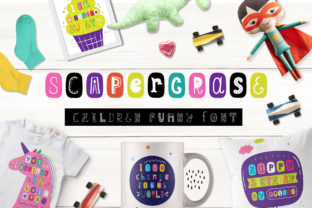
Scapegrace Font: A Whimsical Handwritten Typeface for Playful, Human-Centered Design
Imagine a font that doesn’t just communicate words—but smiles, winks, and invites you to lean in closer. That’s Scapegrace: a stunning, fully hand-drawn, playful handwritten typeface brimming with whimsical charm and expressive personality. Whether you're designing a boutique wedding invitation, an indie brand’s packaging, or a joyful children’s book cover, Scapegrace adds warmth, authenticity, and lighthearted energy that digital precision alone can’t replicate.
What Is Scapegrace—And Why Does It Stand Out?
Scapegrace is more than a decorative script—it’s a carefully crafted, OpenType-enabled handwritten font family designed by Typemade, a respected independent type foundry known for thoughtful, human-first typography. Unlike many “handwritten” fonts generated from automated tools or traced vectors, Scapegrace was drawn entirely by hand using real ink and paper, then digitized with meticulous attention to natural stroke variation, organic spacing, and expressive rhythm.
Its defining traits include:
- True-to-life imperfections—subtle inconsistencies in line weight, letter slant, and baseline alignment that mimic authentic handwriting;
- Rich OpenType features, including contextual alternates, swashes, ligatures, and stylistic sets that let designers fine-tune character combinations for visual harmony;
- Two distinct weights: Scapegrace Regular and Scapegrace Bold—each offering the same lively character but with flexible impact for hierarchy and emphasis;
- Cross-platform compatibility, working seamlessly in Adobe Creative Cloud apps (Illustrator, Photoshop, InDesign), Figma, Affinity Suite, and modern web environments via CSS
@font-faceembedding.
The Purpose Behind the Playfulness
At its core, Scapegrace serves a powerful design purpose: human connection. In an era saturated with sleek, minimalist sans-serifs and algorithmically optimized UI fonts, Scapegrace answers a quiet but growing need—for warmth, approachability, and emotional resonance. It’s not meant for body text in long-form articles or legal disclaimers. Instead, it thrives where tone matters most: headlines, logos, social media graphics, greeting cards, product labels, and experiential branding.
Think of it like choosing the right voice for a conversation. You wouldn’t use a robotic monotone to welcome guests into a cozy café—you’d smile, soften your tone, and gesture warmly. Scapegrace does that visually. A bakery named “Honey & Hearth” might use Scapegrace for its logo and chalkboard menu signs; a mindfulness app could feature it in onboarding illustrations to signal gentleness and presence; a small-batch candle brand might stamp it onto soy wax labels to reinforce artisanal care.
Where Scapegrace Fits in Modern Design Ecosystems
Today’s creative workflows blend speed, scalability, and soul—and Scapegrace bridges that gap. Thanks to robust OpenType support, designers don’t sacrifice control for charm. In Figma, for example, enabling Contextual Alternates automatically swaps repetitive letterforms (like double “o”s or “t” + “h” combinations) for more natural-looking variants—no manual tweaking required. In Adobe apps, accessing swashes via the Glyphs panel lets you add elegant flourishes to initials or key words without breaking typographic rhythm.
For developers and marketers, Scapegrace also works beautifully in responsive web contexts—when properly licensed and served via woff2 files. Paired with a clean, highly legible sans-serif (like Inter or Manrope) for supporting text, it creates a balanced, accessible, and memorable visual hierarchy. And because it’s a single-language (Latin-based) font with comprehensive punctuation and numerals, it integrates smoothly into multilingual marketing campaigns targeting English-speaking audiences—including e-commerce product pages, email headers, and landing page hero sections.
Common Misconceptions—Clarified
Before adopting Scapegrace—or any expressive handwritten font—it helps to clear up frequent assumptions:
- “Handwritten fonts are unprofessional.” Not true. Professionalism isn’t defined by sterility—it’s defined by appropriateness. A law firm’s website may demand formality, but a pediatric clinic’s patient welcome banner benefits deeply from friendly, reassuring typography. Scapegrace signals empathy and humanity—qualities increasingly valued in service-driven industries.
- “It’s only for crafty or ‘cute’ projects.” While it shines in lifestyle and creative niches, Scapegrace has been used effectively in tech startups’ launch campaigns, nonprofit storytelling visuals, and even academic conference branding—where the goal is to humanize complex ideas and invite engagement over intimidation.
- “I can just use free handwritten fonts instead.” Many free alternatives lack proper kerning, limited character sets, inconsistent spacing, or missing OpenType features—leading to awkward line breaks, repeated glyphs, or compromised readability. Scapegrace’s commercial license includes full language support, technical polish, and ethical sourcing—making it a reliable, future-proof investment for serious creators.
Practical Tips for Using Scapegrace Well
To get the most out of Scapegrace without compromising clarity or cohesion, keep these best practices in mind:
- Reserve it for display use: Stick to sizes 24px and larger for web, or 18pt+ for print. Avoid setting paragraphs or captions in Scapegrace—it’s designed to captivate, not sustain prolonged reading.
- Pair intentionally: Contrast its playfulness with a neutral, highly legible companion font. Try pairing Scapegrace Bold with IBM Plex Sans for tech-forward brands, or Scapegrace Regular with Merriweather for editorial warmth.
- Test color contrast: Its delicate strokes require sufficient contrast against backgrounds—especially for accessibility compliance (WCAG AA/AAA). Avoid light gray on white or yellow on cream without testing readability.
- Leverage its expressiveness: Use swashes selectively—not on every word, but to highlight a brand name, call-to-action, or emotional anchor (“Yes”, “Love”, “Welcome”). Less is more when charm is this abundant.
Why Scapegrace Matters Beyond Aesthetics
In broader cultural and professional terms, Scapegrace reflects a meaningful shift: away from homogenized, AI-generated uniformity and toward intentional, values-driven design. As consumers grow more attuned to authenticity—checking ingredient lists, researching brand ethics, favoring local makers—typography becomes part of that trust equation. A font like Scapegrace quietly signals care, craftsmanship, and intentionality. It says, “We made this with our hands—and we want you to feel that.”
Educators use it to create welcoming classroom posters; solopreneurs build recognizable personal brands around its friendly voice; UX designers integrate it into micro-interactions—like celebratory success messages or onboarding animations—to increase emotional stickiness. Even in AI-assisted workflows, Scapegrace acts as a vital counterbalance: a reminder that technology should serve human expression—not erase it.
Final Thoughts: Choosing Joy, Intentionally
Scapegrace isn’t just another font in your library—it’s a tool for emotional intelligence in design. It invites us to slow down, prioritize feeling alongside function, and remember that communication is never just about information transfer. It’s about resonance. Connection. Delight.
Whether you're a seasoned art director refining a luxury skincare identity or a student designing their first portfolio website, Scapegrace offers a rare combination: technical excellence, artistic integrity, and pure, unapologetic joy. And in a world that often feels rushed, filtered, and overly polished, that kind of genuine, handwritten warmth isn’t just charming—it’s essential.
Ready to bring playful humanity into your next project? Explore Scapegrace on Typemade’s official site to preview samples, test live text, and license the font for personal or commercial use.