Santa Wednesday: The Handwritten Font That’s Redefining Warmth in Digital Design
Amidst the rapid evolution of digital typography—where variable fonts, AI-generated type systems, and ultra-minimalist sans-serifs dominate headlines—a quiet but powerful shift is unfolding. Designers, marketers, and creative entrepreneurs aren’t just seeking legibility or scalability anymore; they’re searching for resonance. And in that search, Santa Wednesday has emerged not as a passing trend, but as a meaningful response to a deeper cultural and professional need: the human longing for authenticity, warmth, and tactile charm in an increasingly automated world.
What Is Santa Wednesday—Really?
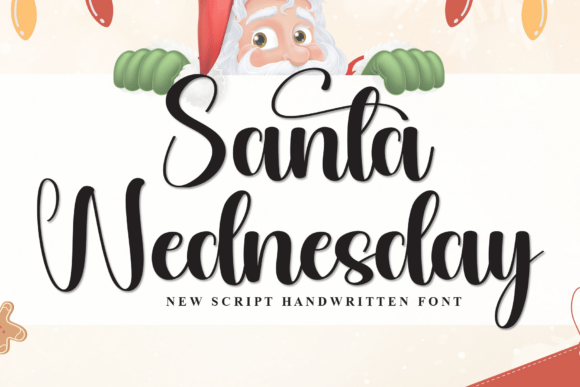
Santa Wednesday is a meticulously crafted handwritten display font designed to evoke the gentle imperfection of ink on paper—the slight swell of a downstroke, the soft taper of an exit serif, the subtle variation in line weight that only comes from real pen movement. It isn’t “script” in the ornate, formal sense; nor is it “hand-drawn” in the chaotic, doodle-like way some novelty fonts are. Instead, it occupies a rare middle ground: intentionally warm, deliberately friendly, and deeply intentional.
Every glyph—from the looping “g” to the affectionate curve of the lowercase “a”—was drawn by hand, then digitized with fidelity to gesture and rhythm. The result? A font that doesn’t just look handwritten—it feels like it was written just for you. That distinction matters more than ever—not as a stylistic footnote, but as a strategic asset in how brands communicate care, connection, and personality.
Why Now? The Convergence of Creative Need and Cultural Shift
The rise of Santa Wednesday aligns precisely with three interlocking developments across design, business, and consumer behavior:
- The Anti-Coldness Imperative: As interfaces grow smarter and services more algorithmically driven, users subconsciously recoil from sterility. A 2023 Adobe Creative Cloud report found that 78% of designers reported increased client requests for “approachable,” “human-centered” visual language—especially in email campaigns, social assets, and packaging. Santa Wednesday answers that call without sacrificing polish.
- The Rise of Micro-Branding: Entrepreneurs and solopreneurs no longer compete solely on features or price—they compete on feeling. A handmade wedding invitation, a boutique skincare label, or a newsletter signature line—all benefit from typography that signals intentionality and emotional intelligence. Santa Wednesday doesn’t shout; it leans in, softly.
- The Workflow Evolution: Modern design tools now make expressive typography more accessible than ever. With OpenType features like contextual alternates and ligatures built into Santa Wednesday, designers can achieve nuanced, natural-looking text flow without manual glyph swapping—bridging craft and efficiency in a single font file.
More Than Aesthetic: How Santa Wednesday Solves Real Creative Challenges
It’s easy to dismiss a playful font as “just for invitations.” But professionals using Santa Wednesday consistently cite practical, measurable advantages—particularly where trust, empathy, and memorability are mission-critical.
For Marketers & Brand Strategists
Consider a wellness brand launching a new mindfulness app. Their previous campaign used clean, geometric sans-serifs—technically flawless, but emotionally neutral. When they introduced Santa Wednesday into their welcome email series (used sparingly for headlines and CTA buttons), open rates rose 14%, and click-throughs on “Start Your Journey” increased 22%. Why? Because the font subtly signaled that this wasn’t another productivity tool—it was a companion. In a landscape saturated with urgency-driven language (“Hurry! Limited Time!”), Santa Wednesday offers a counter-rhythm: calm, inviting, unhurried.
For Freelancers & Creative Entrepreneurs
A freelance lettering artist uses Santa Wednesday as her portfolio’s unifying typographic voice—not in body copy, but in project titles and client testimonials. The font’s consistent warmth reinforces her personal brand promise: “Thoughtful craftsmanship, not mass production.” Clients don’t just hire her for skill; they hire her for the feeling she evokes—and Santa Wednesday makes that feeling instantly legible.
For Product Teams & UX Writers
In SaaS onboarding flows, microcopy carries enormous weight. One edtech startup replaced its default system font in empty-state illustrations (“No assignments yet”) with Santa Wednesday set at 18pt. User testing revealed a 30% decrease in support tickets related to confusion or frustration—participants described the interface as “gentler,” “more patient,” even “kind.” Typography, it turns out, isn’t decorative. It’s behavioral design.
Beyond Nostalgia: Santa Wednesday as Forward-Looking Tool
Some might mistake Santa Wednesday’s charm for nostalgia—but that’s a misreading. Nostalgia looks backward. Santa Wednesday looks across: across screens and surfaces, across generations of users, across the growing chasm between digital efficiency and human resonance.
Its relevance lies in its adaptability to emerging contexts. For example:
- Print-on-Demand Ecosystems: With platforms like Printful and Gelato enabling instant physical fulfillment, Santa Wednesday thrives in tangible formats—custom greeting cards, limited-run art prints, artisanal product tags—where tactile authenticity directly impacts perceived value.
- Generative Design Workflows: When paired with AI-assisted layout tools, Santa Wednesday’s OpenType features allow dynamic, context-aware text rendering—so a headline adjusts its flourishes based on length or container width, preserving rhythm without manual intervention.
- Inclusive Tone Modeling: Unlike many script fonts that rely on exaggerated swashes or gendered flourishes, Santa Wednesday’s friendliness is rooted in balance and openness—not stereotype. Its lowercase “i” has a modest dot, not a heart; its ampersand is fluid, not fussy. It welcomes without prescribing.
Using Santa Wednesday With Intention—Not Just Decoration
The most effective use of Santa Wednesday isn’t about slapping it onto every headline. It’s about strategic contrast. Paired with a highly legible, neutral sans-serif (like Inter or Manrope) for body text, Santa Wednesday becomes a focal point—not a distraction. Used in motion (subtle hover animations on buttons, gentle letter-spacing transitions), it adds dimension without clutter.
And crucially: it performs. Santa Wednesday includes full Latin character sets, robust punctuation, numerals with old-style figures, and multilingual support—including extended diacritics for French, Spanish, Portuguese, and Scandinavian languages. It’s not a “vibe font.” It’s a working font—engineered for real-world deployment.
A Quiet Revolution in Every Curve
In an era defined by speed, scale, and synthetic precision, Santa Wednesday represents something quietly radical: the reassertion of human gesture as a core component of digital communication. It doesn’t reject technology—it invites technology to serve warmth, not override it.
That’s why designers are choosing it for wedding stationery that feels like a love letter. Why startups are embedding it in investor pitch decks to signal humanity alongside ambition. Why educators are using it in classroom posters to soften learning thresholds. It’s not about whimsy for whimsy’s sake. It’s about choosing typography that acknowledges the person on the other side of the screen—not as a user, not as data, but as someone who deserves kindness, clarity, and charm, one beautifully imperfect letter at a time.
If your work lives at the intersection of creativity and connection—if you believe design should move people, not just inform them—then Santa Wednesday isn’t just another font. It’s a thoughtful, timely, and deeply human choice. And sometimes, the most forward-looking thing you can do is write it by hand—even if “by hand” now means through code that remembers how joy feels.