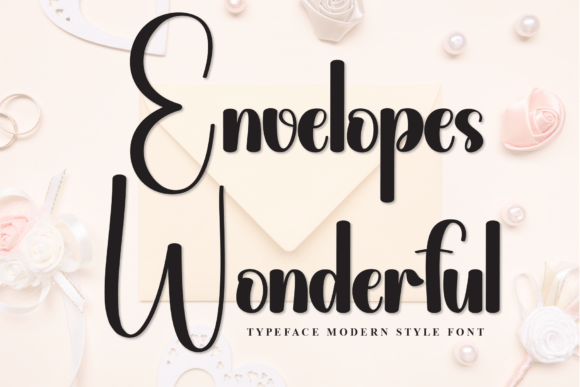
Envelopes Wonderful: Where Handwritten Charm Meets Purposeful Design
Imagine opening an envelope—not a digital notification, but a physical one—and feeling a quiet lift in your spirit before even reading a word. That subtle emotional resonance often begins with the typeface: its curves, spacing, and rhythm whisper intention before meaning arrives. At the heart of this tactile experience lies Sweet and Friendly, a handwritten display font crafted by Envelopes Wonderful to bridge authenticity and artistry in everyday communication.
The Anatomy of Approachability
What makes a font “sweet” or “friendly” isn’t merely decorative—it’s structural. Sweet and Friendly avoids rigid geometry and uniform stroke widths. Instead, it features gently varying line thickness, subtle baseline wobble, and intentionally imperfect joins—details that mirror natural handwriting. These aren’t flaws; they’re cues our brains recognize as human-made, warm, and unhurried. Unlike script fonts that prioritize flourish over function, Sweet and Friendly maintains high legibility at sizes as small as 24pt in print and 36px on screen—crucial for real-world applications where clarity must coexist with charm.
Consider how letterforms behave in context: the lowercase “a” opens generously, inviting the eye; the “g” has a soft, looping tail that guides the reader forward; and the capital “S” curves with restrained confidence—not theatrical, but quietly assured. These micro-decisions accumulate into macro-effects: designs feel more personal, less transactional. That’s why educators printing classroom welcome banners, small-batch candle makers labeling gift boxes, or nonprofit teams designing donor thank-you cards consistently report stronger emotional engagement when using this font—not because it’s “cute,” but because it signals care in execution.
Where Whimsy Serves Strategy
Whimsy, when applied without purpose, can undermine credibility. But Sweet and Friendly demonstrates how playfulness becomes strategic when anchored in consistency and restraint. Its design philosophy centers on *selective emphasis*: it excels as a display face—not body text—and gains power precisely because it’s used sparingly and intentionally.
- Wedding stationery: Couples increasingly seek invitations that reflect their personalities without leaning into cliché. Sweet and Friendly pairs beautifully with minimalist layouts—its warmth softens stark white cardstock, while its organic flow complements botanical illustrations or linen textures. A real-world example: a Portland-based couple used it exclusively for names and dates across save-the-dates, menus, and place cards, reserving clean sans-serifs for logistical details. Guests remarked repeatedly on how “the invitation felt like a hug.”
- Greeting cards and seasonal mailers: In an era of algorithmic feeds, physical mail stands out by virtue of its slowness and tactility. Retailers like independent bookshops and artisan bakeries use Sweet and Friendly for limited-edition holiday cards—not as a full-sentence font, but for salutations (“Dear Book Lover”) and sign-offs (“With flour-dusted hugs”). This selective application builds brand recognition without sacrificing readability.
- Educational materials for early learners: Teachers developing phonics posters or emotion-identification flashcards find Sweet and Friendly supports cognitive processing. Young readers associate rounded, open forms with safety and familiarity. One Montessori educator noted improved letter-recognition retention when using this font alongside sandpaper letters—its shapes echo the motor memory of writing by hand.
Practical Integration: Beyond Aesthetics
Adopting a display font involves more than dragging a file into design software. Effective implementation requires attention to hierarchy, contrast, and context. Here’s what practitioners across fields observe:
First, pairing matters. Sweet and Friendly thrives beside neutral, highly legible companions—think Inter, Source Sans Pro, or even classic serifs like Merriweather. Avoid competing scripts or overly condensed sans-serifs; contrast in tone and structure is essential. A common misstep? Using it for full paragraphs. Its strength lies in focal points: headlines, quotes, names, and short callouts.
Second, color and weight interact meaningfully. The font includes only a single weight—but its expressive nature means ink density and paper choice dramatically affect perception. Printing on uncoated cotton paper deepens its warmth; laser-printing on glossy stock can mute its organic texture. Designers testing mockups recommend softening black ink to 90% K for letterpress or foil-stamping applications, letting the paper’s tooth show through and enhancing tactility.
Third, accessibility considerations are non-negotiable. While Sweet and Friendly meets WCAG AA contrast standards at recommended sizes, it should never be the sole carrier of critical information (e.g., legal disclaimers, allergen warnings, or emergency instructions). Always provide fallbacks—either visually adjacent text in a system font or alt-text in digital formats.
Who Benefits—and Why It Extends Beyond Creatives
Though often associated with designers and crafters, Sweet and Friendly serves functional needs across diverse roles:
- Small business owners use it to differentiate packaging in crowded markets—handmade soap labels, local coffee bags, or boutique clothing tags. Its uniqueness reduces visual fatigue for repeat customers browsing shelves or online galleries.
- Researchers documenting qualitative work incorporate it into presentation slides when quoting participant voices, subtly reinforcing the human-centered ethos of their methodology.
- Hobbyists restoring vintage correspondence appreciate its compatibility with historical aesthetics—its x-height and spacing harmonize with scanned 1940s typewriter specimens or mid-century postcard lettering, enabling authentic-feeling recreations.
- Nonprofit communicators deploy it in stewardship reports to soften data-heavy sections—pairing a chart title in Sweet and Friendly with explanatory body copy in a readable serif creates psychological breathing room, encouraging deeper engagement with impact metrics.
Technical Nuances That Shape Real-World Use
Envelopes Wonderful built Sweet and Friendly with practical typography in mind—not just visual appeal. It includes full Latin character sets, standard punctuation, and OpenType features like contextual alternates and discretionary ligatures. These aren’t just “nice-to-haves”: contextual alternates prevent awkward collisions between letters like “f” and “l” or “r” and “e,” ensuring consistent rhythm across words. Discretionary ligatures (e.g., “Th,” “Qu”) add polish without demanding manual substitution—valuable for time-constrained educators preparing classroom materials or volunteers designing community event flyers.
File format flexibility also supports workflow diversity: the font ships in .OTF and .TTF variants, compatible with Adobe Creative Cloud, Affinity Suite, Canva (via upload), and desktop publishing tools like Scribus. For web use, Envelopes Wonderful provides WOFF2 files optimized for fast loading—critical for hospitality sites embedding reservation confirmations or wedding planners embedding interactive timelines.
When Simplicity Becomes Sophistication
In design discourse, “simplicity” is often misread as minimalism—or worse, reduction. Sweet and Friendly redefines it as *intentional distillation*. Every curve was refined over dozens of iterations to balance recognizability and expressiveness. There are no gratuitous swashes, no forced elegance—just forms shaped by the belief that joy resides in honesty, not ornamentation.
This principle resonates beyond aesthetics. Consider how a therapist might use the font on a printed wellness worksheet: its openness invites reflection rather than intimidation. Or how a city parks department uses it on trailhead signage for community art walks—its friendliness lowers perceived barriers to participation. These aren’t niche applications; they’re evidence that thoughtful typography operates at the intersection of psychology, usability, and cultural resonance.
Ultimately, Sweet and Friendly endures because it answers a quiet but persistent need: to communicate with humanity intact. In a world saturated with algorithmically generated content and templated visuals, choosing this font is a small but meaningful act of resistance—a declaration that some messages deserve the weight of hand-guided intention, the warmth of imperfection, and the quiet confidence of being exactly what they are: wonderful, envelope-worthy, and deeply human.