Hello Stylish: Where Timeless Handwritten Charm Meets Modern Design Precision
Typography is rarely neutral—it carries tone, signals intention, and shapes perception before a single word is read. Among the growing landscape of script fonts, Hello Stylish stands apart not because it shouts, but because it invites: warm, confident, and effortlessly legible. It’s not merely decorative; it’s a functional tool built for clarity and character in equal measure. Designed with intention—not trend—it bridges the human touch of handwriting with the reliability digital workflows demand.
The Quiet Strength of a Thoughtfully Crafted Script
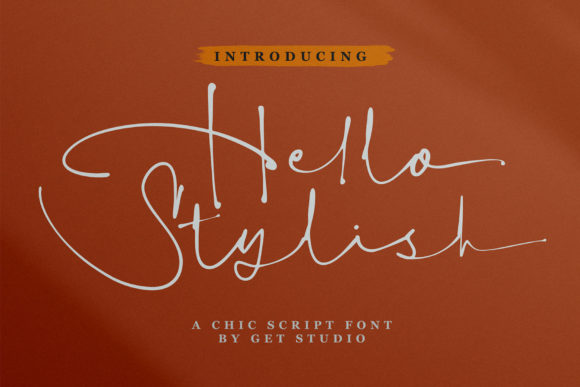
Many handwritten fonts sacrifice readability for flourish—or worse, consistency for charm. Hello Stylish avoids that trade-off. Its letterforms balance natural variation with disciplined spacing and rhythm. Ascenders rise with gentle confidence; descenders settle without heaviness; terminals taper cleanly rather than flicker unpredictably. This isn’t simulated handwriting—it’s designed handwriting: refined through iteration, tested across sizes and contexts, and calibrated for visual harmony.
What makes this possible is its underlying structure. Unlike rushed brush scripts or overly ornate calligraphic revivals, Hello Stylish begins with a consistent pressure model—subtle thicks and thins follow logical stroke direction, mimicking how a pen naturally behaves. That grounding allows it to scale gracefully: from a 12-pt caption on a product label to a 120-pt hero headline on a boutique website—legibility remains intact, not an afterthought.
PUA Encoding: Glyph Access Without Guesswork
A technical detail that quietly transforms workflow efficiency is Hello Stylish’s PUA (Private Use Area) encoding. For designers, developers, and content creators alike, this means every alternate glyph, swash, ligature, and stylistic set is accessible directly—no need for complex OpenType feature toggles, CSS font-feature-settings gymnastics, or workarounds in non-professional software.
In practice, this translates to real-time creative control. Typing “Hello” might default to standard forms—but pressing a single key combination (or selecting from a glyph palette in design apps like Adobe Illustrator or Affinity Designer) reveals a subtle entrance swash on the capital “H”, a contextual exit flourish on the final “o”, or a connected “ll” ligature that improves flow. These aren’t gimmicks; they’re typographic refinements that elevate tone—making a wedding invitation feel more personal, a brand manifesto feel more considered, or a teacher’s classroom poster feel more inviting.
For educators building printable resources or researchers designing presentation slides, PUA access means consistency across platforms. A swash glyph inserted in Canva behaves the same in Google Slides or Microsoft PowerPoint—no unexpected substitutions, no missing characters. That predictability saves time and preserves intent.
Real-World Applications Across Diverse Contexts
Where does Hello Stylish truly shine? Not in isolation—but where authenticity meets purpose.
Branding That Feels Human, Not Generic
Small businesses—especially those rooted in craft, wellness, education, or local service—often struggle to differentiate in saturated digital spaces. A sterile sans-serif may communicate efficiency, but it rarely conveys care. Hello Stylish offers an alternative: a logo that feels hand-signed by the founder, not generated by an algorithm. A yoga studio’s wordmark in Hello Stylish suggests presence and intention; a handmade ceramics brand uses its soft curves to echo the tactile quality of its products; a tutoring service deploys its friendly openness to signal approachability—without sacrificing professionalism.
Print and Packaging With Personality
On physical touchpoints—product tags, greeting cards, recipe cards, or boutique packaging—Hello Stylish performs exceptionally. Its ink-like contrast and organic texture translate beautifully to print, especially on uncoated or textured papers. Unlike ultra-thin scripts that vanish on kraft stock, Hello Stylish maintains weight and definition at small sizes. A candle label using its medium-weight variant reads clearly at 8 pt, while its bold swash version commands attention on a 24” shelf banner.
Digital Interfaces That Breathe
In UI design, script fonts are often avoided—rightly so, when they hinder scannability. Hello Stylish, however, works effectively as a secondary typeface: for section headers in a portfolio site, pull quotes in long-form articles, or call-to-action buttons where emotional resonance matters more than speed of parsing. Paired with a clean, highly legible sans-serif (like Inter, Lato, or even system fonts), it creates visual hierarchy with warmth—not clutter.
Educational and Creative Tools
Teachers creating worksheets, habit trackers, or classroom posters benefit from Hello Stylish’s dual nature: it’s familiar enough to feel accessible to young learners, yet sophisticated enough to avoid infantilizing older students. Its open counters and generous x-height improve recognition for emerging readers. Meanwhile, hobbyists crafting digital planners or bullet journal templates use its swashes to add gentle visual punctuation—turning a simple checklist into something that feels curated and intentional.
Practical Considerations for Informed Use
Even excellent tools require thoughtful application. Hello Stylish excels—but knowing its boundaries strengthens implementation.
- Not for body text: Like most high-character scripts, it’s designed for impact, not endurance. Reserve it for headings, logos, short quotes, or accent elements—not paragraphs or data tables.
- Weight matters: Hello Stylish typically ships in multiple weights (Light, Regular, Bold). The Regular weight balances elegance and clarity best for most display uses; Bold adds presence for large-scale applications but can lose nuance at smaller sizes.
- Language support: While optimized for English and major Western European languages (with accents and diacritics included), users working with extended character sets (e.g., Central/Eastern European, Turkish, or Baltic) should verify coverage in the specific version they license.
- Licensing clarity: Hello Stylish is commonly offered under desktop, web, and app licenses. Educators using it in publicly shared Google Slides templates or designers embedding it in client websites must confirm usage rights match the deployment context—avoiding unintentional compliance gaps.
Beyond Aesthetics: Why This Font Endures
Trends cycle quickly—grunge, vaporwave, ultra-minimalism—but enduring typography answers deeper needs: clarity, connection, and coherence. Hello Stylish succeeds because it responds to a quiet cultural shift: audiences increasingly value authenticity over polish, warmth over sterility, and craft over convenience.
Consider how consumers respond to brands. A 2023 Stanford study on perceived trust in digital interfaces found that users consistently rated interfaces incorporating carefully chosen handwritten elements as “more trustworthy” and “more likely to reflect real people behind the product”—provided the script was legible and context-appropriate. Hello Stylish fits that narrow, valuable band: expressive enough to humanize, restrained enough to remain credible.
For creators, it lowers the barrier between idea and execution. You don’t need calligraphy training to evoke sincerity—you need a well-designed tool that honors the gesture of the hand while respecting the constraints of the screen and press. That balance is rare. It’s why illustrators pair it with line art, why UX writers use it to soften error messages, and why nonprofit campaigns deploy it to make statistics feel grounded in human experience.
Integrating Hello Stylish Into Your Workflow
Adoption is straightforward—but intentionality multiplies impact.
- Start with purpose: Before applying Hello Stylish, ask: What emotion or value should this element convey? If the answer is “urgency” or “technical precision”, another typeface may serve better.
- Test early, test physically: Render samples at actual size—on screen and printed. Does the “a” distinguish clearly from the “o”? Does the “g” read instantly? Swashes shouldn’t obscure meaning.
- Pair deliberately: Its natural counterpart is a neutral, highly legible sans-serif with similar x-height and proportions. Avoid clashing contrasts—e.g., pairing Hello Stylish with an ultra-condensed or distressed sans undermines both.
- Leverage PUA proactively: Don’t treat alternates as decoration. Use entrance swashes on first letters of headings; exit swashes on final words of quotes; discretionary ligatures only where they improve rhythm (e.g., “fi”, “fl”, “ff”).
- Respect hierarchy: One Hello Stylish element per visual zone is usually enough. Overuse dilutes its power—and risks visual fatigue.
In a world accelerating toward AI-generated uniformity, Hello Stylish offers something quietly radical: a reminder that the most compelling communication still begins with the human hand—and ends with thoughtful, precise design. It doesn’t chase novelty. It delivers reliability wrapped in grace. And for professionals, educators, makers, and business owners alike, that combination isn’t just attractive—it’s essential.