Camp Ground: Where Handwritten Warmth Meets Design Intentionality
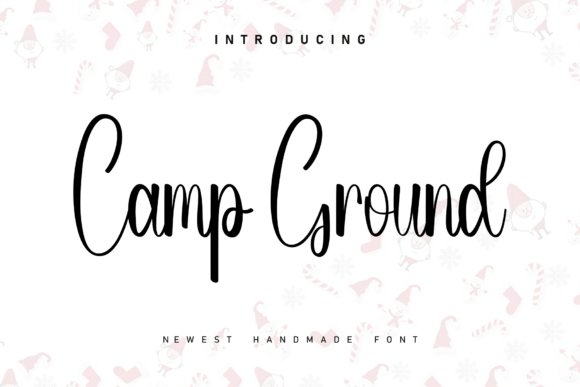
Typography is rarely neutral—it carries tone, signals context, and quietly shapes how information is received. Among the thousands of fonts available today, Camp Ground stands apart not for technical innovation or historical pedigree, but for its unmistakable emotional resonance. It’s a sweet and beautiful handwritten font—deliberately imperfect, gently rhythmic, and deeply human. Its characters don’t sit rigidly on the baseline; they dance along it, rising and falling with subtle variation, as if penned by a relaxed hand in a sunlit cabin or beside a crackling fire. That movement isn’t decorative flourish—it’s functional warmth made visible.
The Anatomy of Approachability
What makes Camp Ground feel so inviting—and why does that matter beyond aesthetics? At its core lies intentional irregularity. Unlike many script fonts that prioritize elegance through uniform slant or exaggerated flourishes, Camp Ground embraces gentle inconsistencies: some letters lean slightly left, others rest upright; ascenders vary in height; terminals taper softly rather than ending in sharp points. These aren’t flaws—they’re cues our brains recognize from authentic handwriting, triggering subconscious associations with sincerity, care, and approachability.
This isn’t mere stylistic preference. Research in cognitive psychology shows that moderately irregular, human-like visual stimuli are more memorable and emotionally engaging than perfectly geometric alternatives—especially in contexts where trust and relatability matter most. A business card set in Camp Ground doesn’t shout “professional” in the corporate sense—but it whispers “I see you,” “I’m thoughtful,” and “This was made with attention.” That distinction is critical when designing for audiences who value authenticity over authority: small-batch artisans, community educators, wellness practitioners, indie publishers, and local nonprofits.
Real-World Applications Beyond Decoration
Many assume handwritten fonts belong only in invitations or social media graphics. But Camp Ground thrives where hierarchy and empathy intersect—particularly in layered, content-rich environments. Consider a children’s literacy app: using Camp Ground for vocabulary prompts (e.g., “Find the word that rhymes with *tree*”) creates immediate visual softness, reducing cognitive load for emerging readers without sacrificing legibility. Its open counters and generous x-height ensure clarity even at 18–24px sizes on tablet screens.
In education, teachers use Camp Ground to craft classroom posters that feel like personal notes—not institutional mandates. A science bulletin board titled “How Bees Talk” gains quiet authority when the heading is set in Camp Ground, while supporting facts remain in a clean sans-serif. The contrast doesn’t distract—it directs attention with emotional precision. Similarly, therapists and counselors integrate it into printable reflection worksheets: the font’s rhythm mirrors the cadence of mindful breathing, subtly reinforcing the activity’s purpose before a single word is read.
For small businesses, Camp Ground solves a common identity dilemma. A neighborhood bakery doesn’t need to mimic luxury branding to signal quality—it can convey craft and care through texture. Using Camp Ground on chalkboard-style menu boards (digitally rendered or printed), packaging labels, or seasonal email headers communicates continuity: same hands, same ingredients, same intention across touchpoints. Crucially, it scales gracefully—from tiny embroidery on aprons (when used sparingly in bold weight) to large-format window decals—because its personality lives in proportion and spacing, not just stroke width.
Strategic Pairing: When Camp Ground Leads, Follows, or Anchors
No font exists in isolation—and Camp Ground’s strength lies in how thoughtfully it collaborates. Its most effective pairings share a commitment to clarity, not similarity. Avoid competing scripts or overly ornate serifs; instead, choose companions that provide structural counterbalance:
- Neutral sans-serifs like Inter, Lato, or even system fonts (Helvetica Neue, Segoe UI) create crisp contrast. Use Camp Ground for headlines or callouts; the sans-serif handles body text, captions, and data with calm efficiency.
- Low-contrast serifs such as Literata or PT Serif work beautifully in editorial layouts—Camp Ground for pull quotes or section dividers, the serif for narrative flow. Their shared warmth prevents visual whiplash.
- Monospaced fonts (e.g., IBM Plex Mono, Fira Code) form unexpectedly grounded duos in tech-adjacent contexts. A developer advocacy site might use Camp Ground for mission statements (“We build tools that feel like helping hands”) alongside code snippets in monospace—bridging humanity and precision.
What doesn’t work? Overloading. Because Camp Ground carries distinct voice, it loses impact when surrounded by three other expressive typefaces. It also requires breathing room: tight tracking or cramped line heights mute its natural rhythm. For optimal readability in longer passages, limit usage to 30–50 characters per line when used for display text, and always test at actual viewing distance—what reads warmly on a desktop may feel cramped on mobile without adjusted sizing or spacing.
Accessibility and Inclusive Considerations
Handwritten fonts often raise legitimate accessibility questions—and rightly so. Camp Ground was designed with legibility as a foundational constraint, not an afterthought. Its letterforms avoid problematic ambiguities: the lowercase a and o are distinctly shaped; i and l differ clearly in width and terminal treatment; numerals are tabular and unambiguous (0 has a dot, 1 has a base). Still, best practices apply:
- Never rely solely on Camp Ground for essential interface text (button labels, form fields, navigation links).
- Ensure sufficient color contrast—especially against textured or photographic backgrounds. Its light weight demands careful background selection.
- When used in digital products, pair it with semantic HTML and ARIA labels where meaning depends on visual styling alone (e.g., a decorative divider styled with Camp Ground should not convey critical information).
Importantly, accessibility here extends beyond compliance. For neurodivergent users, the font’s organic flow can reduce visual stress compared to high-contrast, tightly spaced geometric type. Educators report improved engagement from students with ADHD during reading activities when headings use Camp Ground—not because it’s “easier to read,” but because its rhythm provides gentle visual scaffolding, anchoring attention without demanding it.
Workflow Integration: From Concept to Consistent Execution
Adopting Camp Ground successfully isn’t about swapping one font for another—it’s about aligning typographic choice with communication goals. Start by auditing existing assets: where do you currently use generic scripts or overused handwriting fonts? Identify one high-impact, low-risk opportunity—a welcome email series, a workshop handout, or a product feature announcement—and prototype with Camp Ground. Pay attention not just to appearance, but to response: Do recipients comment on tone? Does engagement time increase? Does team members find it easier to articulate brand voice?
For teams, establish simple usage guidelines early: define primary and secondary weights (regular and bold are typically sufficient), specify size ranges for different contexts (e.g., 36–60px for hero headers, 24–32px for section titles), and document approved pairings. Avoid “font committees”—instead, empower designers and content creators with principles (“Use Camp Ground when introducing something human-centered, not when explaining complex systems”) rather than rigid rules.
Developers benefit from clear implementation notes: Camp Ground includes full Latin character sets, basic diacritics, and standard punctuation—no need for fallback gymnastics in English-language projects. For multilingual sites, verify glyph coverage for target languages before launch; while robust, it’s not exhaustive for extended Cyrillic or CJK support.
A Font That Grows With Purpose
Fonts age—not mechanically, but culturally. What feels fresh and genuine in one era risks cliché in another. Camp Ground avoids this trap through restraint. It doesn’t mimic calligraphy tools or simulate ink bleed; it captures the quiet confidence of someone writing slowly, deliberately, without performance. That timelessness isn’t accidental. It emerges from observing how people actually write when they’re present—not hurried, not performing, but communicating with care.
That’s why educators return to it for student-facing materials, why researchers use it in community-engaged project reports, and why founders choose it for investor decks focused on social impact: it signals that the work matters not just for its outcomes, but for its ethos. It doesn’t promise efficiency—it promises attention. And in a world saturated with algorithmically optimized, frictionless interfaces, that kind of attention is increasingly rare, increasingly valuable, and increasingly necessary.
Ultimately, Camp Ground invites a shift in design thinking—from asking “What font looks good here?” to “What feeling needs to be felt first?” When the answer is warmth, sincerity, or quiet invitation, Camp Ground doesn’t just fit—it fulfills.