Children Promise Font: A Friendly, Whimsical Handwritten Typeface for Modern Design
Whether you're crafting a heartfelt birthday invitation, designing a playful social media graphic, or branding a small business that values warmth and authenticity, typography plays a quiet but powerful role. Among the many handwritten fonts available today, Children Promise stands out—not for its complexity, but for its thoughtful simplicity. This clean, cute, and highly legible handwritten font brings a gentle, friendly energy to any project. In this article, we’ll explore what makes Children Promise special, why it matters in real-world design, and how you can use it effectively—whether you're a beginner designer, educator, entrepreneur, or creative hobbyist.
What Is Children Promise?
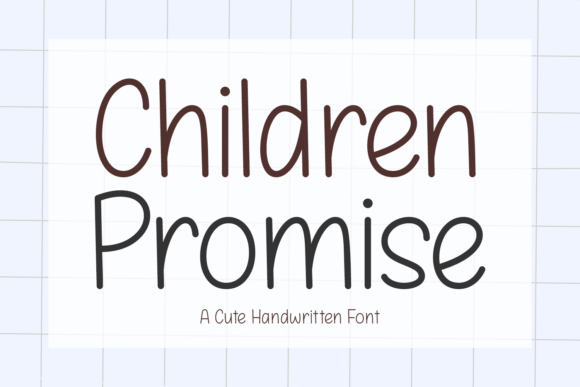
Children Promise is a modern handwritten typeface designed with clarity and charm in mind. Unlike some script fonts that lean heavily into ornate flourishes or exaggerated slants, Children Promise prioritizes readability without sacrificing personality. Its letters mimic natural pen strokes—slightly rounded, gently angled, and consistently spaced—giving text a relaxed, approachable feel. The name itself evokes sincerity and warmth, reinforcing the font’s emotional tone: honest, kind, and full of quiet intention.
Developed with digital usability in mind, Children Promise includes full Latin character support, numerals, punctuation, and common diacritical marks—making it practical for multilingual projects and everyday use. It’s optimized for both screen and print, ensuring your invitations look lovely on mobile devices and your classroom posters remain crisp when printed at large sizes.
Why Choose a Handwritten Font Like Children Promise?
Typography isn’t just about aesthetics—it’s about communication. Fonts carry subtle emotional cues. Serif fonts (like Times New Roman) often suggest tradition or authority; sans-serifs (like Helvetica) imply modernity and neutrality. Handwritten fonts, by contrast, signal human connection. They say, “This was made with care,” “I’m speaking to you personally,” or “There’s joy in this message.”
Children Promise takes that idea a step further. Because it avoids overly dramatic swashes or tight letter spacing, it remains accessible and inclusive—especially important for audiences that include children, neurodivergent readers, or older adults. Its open counters (the enclosed spaces inside letters like ‘a’, ‘e’, and ‘o’) and generous x-height improve legibility at smaller sizes, making it ideal for digital interfaces where clarity is non-negotiable.
Where Does Children Promise Shine?
- Branding for Small Businesses: Cafés, boutiques, wellness studios, and handmade goods shops often use Children Promise to convey authenticity and approachability—without looking unprofessional.
- Educational Materials: Teachers use it for classroom signs, reading worksheets, and student handouts because its friendly shape supports early literacy development and reduces visual fatigue.
- Social Media & Digital Content: Instagram story headers, Pinterest quote graphics, and TikTok captions gain instant warmth and relatability with Children Promise—helping content stand out in fast-scrolling feeds.
- Personal & Celebratory Projects: Wedding stationery, baby shower invites, birthday cards, and memory books all benefit from its tender, celebratory tone.
Common Misconceptions About Handwritten Fonts
Many people assume handwritten fonts are only for “cute” or “childish” contexts—or worse, that they’re inherently unprofessional. That’s a myth. The professionalism of a font depends less on its style and more on how it’s used. Children Promise proves this point: when paired with thoughtful layout, appropriate color palettes, and consistent hierarchy, it supports serious messaging with sincerity—not silliness.
Another misconception is that all handwritten fonts are hard to read. While some decorative scripts blur letterforms for artistic effect, Children Promise was intentionally engineered for legibility. Its lowercase ‘a’ and ‘g’ follow familiar single-story forms (not the more complex double-story versions), and its ‘i’ and ‘l’ are clearly differentiated—critical for avoiding confusion in names, dates, or instructions.
How Children Promise Fits Into Today’s Creative Landscape
In an era dominated by AI-generated visuals and algorithm-driven content, human-centered design is experiencing a resurgence. Consumers increasingly value brands and creators who feel genuine—not polished to perfection, but thoughtfully present. Children Promise aligns perfectly with this shift. It doesn’t try to imitate calligraphy masters or mimic vintage ink; instead, it offers a contemporary interpretation of handwriting—one that feels both intentional and effortless.
From a technical standpoint, Children Promise also reflects evolving web standards. It’s lightweight (under 50 KB as a WOFF2 file), supports variable font features like optical sizing, and works seamlessly with CSS @font-face declarations. Developers can integrate it into websites without sacrificing performance—a key consideration for SEO and Core Web Vitals.
Real-World Examples You Can Learn From
- A Local Bakery’s Website: Using Children Promise for menu headings and “Our Story” section titles adds warmth while keeping body text in a neutral sans-serif—creating balance and guiding attention naturally.
- An Elementary School Newsletter: Teachers combine Children Promise for student quotes (“This week I learned…”) with a simple sans-serif for schedules and announcements—enhancing engagement without compromising function.
- An Eco-Friendly Product Launch: A sustainable skincare brand uses Children Promise on product labels and packaging to emphasize care, craftsmanship, and transparency—reinforcing brand values before customers even read the copy.
Getting Started With Children Promise
Using Children Promise is straightforward—and no design degree is required. Most platforms support it through easy integrations:
- Canva & Adobe Express: Search “Children Promise” in the font library—no upload needed.
- Web Projects: Download the font files (OTF, WOFF2), host them locally or via a CDN, and declare them using
@font-facein your CSS. - Print & Desktop Design: Install the font on your computer and select it in apps like Illustrator, InDesign, or even Microsoft Word.
Pro tip: Pair Children Promise with a clean, minimalist sans-serif (like Inter, Lato, or Montserrat) for contrast and structure. Avoid pairing it with other script fonts—that can create visual competition and reduce impact.
Final Thoughts: More Than Just a Font
Children Promise is more than a collection of glyphs—it’s a tool for empathy in design. In classrooms, it helps young learners feel seen. In businesses, it builds trust through tone. In personal projects, it turns ordinary messages into meaningful moments. Its strength lies not in flashiness, but in fidelity—to human rhythm, to clarity, and to kindness in communication.
As digital tools grow more powerful, the need for grounded, emotionally intelligent design grows stronger too. Choosing a font like Children Promise is a small decision with ripple effects: it invites pause, encourages connection, and reminds us that behind every pixel is a person hoping to be understood. Whether you're drafting a note to a friend or launching a new brand, let your typography reflect the promise you want to keep—gently, clearly, and with heart.