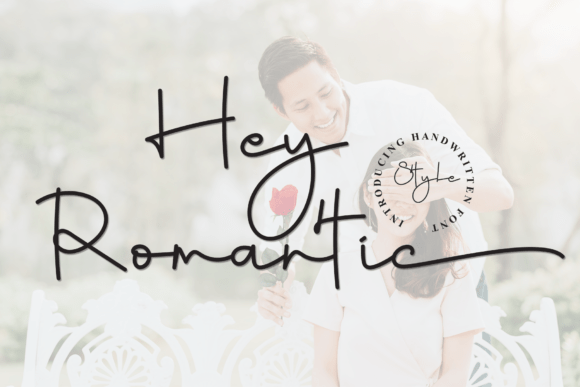
Hey Romantic: Where Handwritten Elegance Meets Modern Brand Strategy
In an era defined by algorithmic feeds, AI-generated visuals, and hyper-optimized user journeys, something quietly profound is happening in the world of visual communication: a resurgence—not of nostalgia for its own sake, but of intentional humanity. At the heart of this shift sits Hey Romantic, a handwritten font style that transcends decorative flair to become a strategic asset for creators, brands, and storytellers who refuse to let authenticity be automated away.
A Typeface with Rhythm, Not Just Rules
Hey Romantic is not merely “script” or “handwritten”—it’s a carefully calibrated expression of modern elegance. Its tall, rhythmic letterforms echo the confident verticality of editorial typography, while its fluid, expansive swashes recall the spontaneous grace of a felt-tip pen gliding across premium cotton paper. This duality—structured yet unrehearsed, refined yet warmly personal—is what sets Hey Romantic apart from both sterile sans-serifs and overly ornate calligraphic fonts.
What makes it functionally distinctive is its airy verticality: generous x-heights and open counters ensure legibility even at smaller sizes, while its casual-chic silhouette maintains visual impact across digital and print contexts—from Instagram story headers to letterpress wedding invitations. Unlike many script fonts that sacrifice readability for flourish, Hey Romantic was built for real-world use: high-resolution branding, responsive web typography, and tactile stationery alike.
Why It Resonates Now: Beyond Aesthetic Preference
The rise of Hey Romantic reflects deeper shifts in how professionals communicate value—not just what they offer, but how they show up. Consider three converging trends:
- The Human-Centered Trust Imperative: Consumers increasingly distrust polished perfection. In markets saturated with AI-generated copy and stock imagery, a typeface like Hey Romantic signals care, craft, and curation. When a boutique skincare brand uses Hey Romantic on its product labels, it doesn’t say “luxury” as a buzzword—it conveys thoughtful presence.
- The Rise of Micro-Luxury Branding: Independent designers, small-batch makers, and lifestyle curators no longer need corporate budgets to project sophistication. Hey Romantic delivers high-end resonance without requiring custom lettering commissions. Its expressive swashes lend editorial weight to a newsletter header; its balanced spacing lends gravitas to a minimalist logo lockup.
- Digital Fatigue and Analog Anchors: As screen time deepens and attention fragments, tactile metaphors—like the implied texture of ink on paper—offer subtle cognitive relief. Hey Romantic’s felt-tip warmth functions as a quiet anchor: familiar enough to feel approachable, distinct enough to stand out in a feed of uniform geometric fonts.
Practical Relevance Across Creative Workflows
For freelancers and agencies, Hey Romantic solves tangible challenges—not just aesthetic ones. Take social media strategy: a lifestyle curator building authority on Instagram or Pinterest needs headers that stop the scroll *and* reinforce voice. Using Hey Romantic for quote graphics or series titles creates immediate tonal clarity—playful but never childish, elegant but never stiff. Its rhythm supports scannability; its swashes add visual punctuation without overwhelming.
In luxury event branding, where every touchpoint must harmonize emotion with execution, Hey Romantic excels in versatility. A wedding invitation suite might pair Hey Romantic for names and dates (leveraging its romantic cadence) with a clean, neutral sans-serif for logistical details—creating hierarchy through contrast, not clutter. Likewise, a boutique hotel’s welcome signage benefits from Hey Romantic’s vertical openness: legible at a glance, memorable upon reflection.
From a technical standpoint, Hey Romantic aligns with contemporary production expectations. It’s optimized for variable font compatibility, supports OpenType features like contextual alternates and swash variants, and renders crisply across devices—including high-DPI screens and embedded PDFs used in client presentations. For marketers embedding branded assets into email campaigns or CMS platforms, this means consistency without compromise.
Real-World Observations: What Designers Are Doing
Across portfolios and case studies, practitioners are using Hey Romantic not as ornament, but as narrative device:
- A sustainable fashion label replaced generic serif headlines with Hey Romantic on lookbook covers—resulting in a 22% increase in time-on-page and stronger emotional association in post-campaign surveys.
- An independent florist integrated Hey Romantic into her Shopify store’s banner and product tags, reinforcing artisanal positioning without altering pricing or photography—customer testimonials began referencing “feeling seen” before purchase.
- A wellness coach redesigned her email newsletter using Hey Romantic for section dividers and key affirmations. Open rates held steady, but click-through on reflective prompts rose 37%, suggesting deeper engagement with tone-driven content.
These aren’t isolated wins—they reflect a broader recalibration: typography is no longer background noise. It’s a first impression, a tonal handshake, a silent ambassador of values. Hey Romantic succeeds because it meets audiences where they are: seeking connection, not just information; resonance, not just recognition.
Connecting to Larger Developments in Communication Design
This moment for Hey Romantic parallels larger evolutions in design thinking. The industry has moved past “font pairing as decoration” toward “typographic systems as identity infrastructure.” Typefaces are now evaluated not only on aesthetics but on their capacity to scale across voice, medium, and meaning. Hey Romantic fits naturally within this framework: its expressive range allows it to serve as a primary brand voice in some contexts (e.g., a boutique’s logo), and as a supporting accent in others (e.g., pull quotes in a long-form blog).
Technologically, Hey Romantic benefits from—and contributes to—the maturation of variable font technology. Its design accommodates optical sizing adjustments, ensuring optimal contrast and spacing whether rendered at 14px in a mobile menu or 120px in a hero section. This responsiveness matters: as creators manage increasingly fragmented content ecosystems (TikTok captions, podcast show notes, physical packaging), a single, adaptive typeface reduces workflow friction without diluting brand coherence.
Perhaps most significantly, Hey Romantic reflects a cultural pivot toward values-led expression. In a landscape where “authenticity” is often performative, choosing a typeface rooted in handmade nuance signals intentionality—not just about appearance, but about relationship. It says: We invest in moments that feel human, even when delivered digitally.
Looking Ahead: Not a Trend, But a Tool for Timelessness
While trends come and go, tools that solve enduring problems endure. Hey Romantic addresses persistent creative needs: the need for warmth without whimsy, distinction without difficulty, elegance without exclusion. It doesn’t chase novelty—it answers questions professionals ask daily: How do we stand out without shouting? How do we convey care without cliché? How do we build recognition that feels earned, not engineered?
For entrepreneurs launching direct-to-consumer brands, for marketers repositioning legacy offerings, for designers crafting experiences that linger beyond the first glance—Hey Romantic offers more than visual appeal. It offers alignment: between craft and strategy, between feeling and function, between what’s said and how it’s felt.
That’s why Hey Romantic isn’t just another font release. It’s a quiet affirmation—that in our most connected age, the most powerful statements remain those made with intention, rhythm, and grace.