Beaching: A Handwritten Display Font That Feels Like Joy in Type
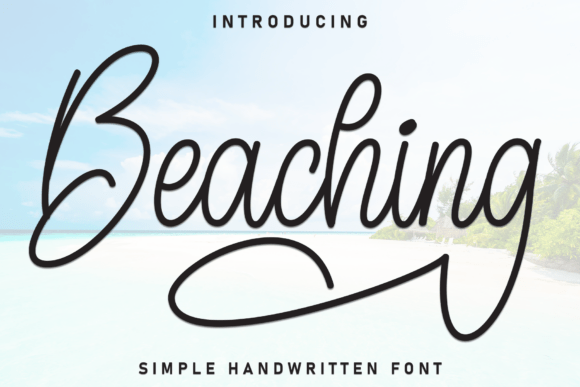
If you've ever spent too long searching for a font that feels alive—not just legible, but expressive, warm, and unmistakably human—then Beaching may be the quiet solution you’ve been overlooking. It’s not another generic script or an over-rendered calligraphy knockoff. Beaching is a carefully crafted handwritten display font designed with rhythm, breath, and intention. Its strokes carry subtle variation: some thick, some delicate, some ending in soft flicks or gentle lifts—just like real pen-on-paper movement. That authenticity is why it resonates so strongly in contexts where personality matters more than precision.
When Personality Outweighs Perfection
Beaching shines where polished uniformity falls flat—like wedding stationery that should whisper “us,” not “template.” Consider a couple hand-selecting fonts for their save-the-dates: they want something that reflects their easy laughter, their shared love of coastal walks and vinyl records. Beaching delivers that tone without requiring custom lettering. Its natural flow and slight irregularities suggest care and craft—not automation. Designers report clients responding emotionally to mockups using Beaching, often saying things like, “That’s *us*,” before even reading the text.
This isn’t about decorative excess. It’s about emotional alignment. When your brand voice leans into warmth, approachability, or lighthearted sincerity—think small-batch bakeries, independent bookshops, mindful wellness studios, or educators building inclusive classroom materials—Beaching helps translate tone into typography. It supports storytelling by giving words a gentle pulse, making them feel spoken rather than typeset.
Practical Strengths Beyond Aesthetics
Beaching includes full Latin character support, standard ligatures, and OpenType features like contextual alternates—meaning letters subtly shift depending on surrounding characters. This avoids the “cut-and-paste” look common in simpler scripts. For example, the lowercase “a” appears in two distinct forms depending on whether it follows “c” or “t,” mimicking natural handwriting cadence. That detail saves time: no manual glyph swapping needed for professional polish.
It also scales well. At 36pt, Beaching reads clearly on a greeting card; at 144pt, it holds its charm on a large-format poster or social media banner. Unlike many playful fonts that blur or lose definition when enlarged, Beaching’s stroke contrast and spacing remain intentional and legible—even in print. That reliability means fewer revisions, less back-and-forth with printers, and more confidence when presenting to clients or stakeholders.
Who Benefits Most—and Why
Creative professionals (freelance designers, branding consultants, wedding stationers) appreciate how Beaching shortens the path from concept to client approval. Instead of layering textures, overlays, or hand-drawn elements to add warmth, they start with Beaching as the typographic foundation—then build outward. One designer shared that using Beaching reduced her average invitation suite revision cycle from four rounds to one or two, simply because the emotional intent landed immediately.
Small business owners—especially those without in-house design help—find Beaching intuitive in tools like Canva or Adobe Express. Its clean file structure and clear naming conventions (no confusing “Beaching-Alt2-Web” variants) mean less time troubleshooting and more time focusing on messaging. A local florist used Beaching across Instagram Stories, email headers, and printed thank-you notes—creating visual continuity without hiring a designer.
Educators and nonprofit communicators also benefit. A literacy tutor told us she uses Beaching for student-facing worksheets because its friendly shape reduces reading anxiety for emerging readers—particularly those who associate rigid, textbook-style fonts with difficulty. It doesn’t replace accessibility best practices, but it complements them by lowering perceptual barriers.
Where Beaching Fits—and Where It Doesn’t
Beaching is intentionally a display font. That means it excels at headlines, quotes, logos, packaging accents, and short-form text—but it’s not built for body copy. Trying to set a 500-word blog post in Beaching would strain readability and dilute its impact. Think of it like a well-placed accent color: powerful in moderation, overwhelming in excess.
It also assumes a certain design context. If your project demands strict corporate neutrality (e.g., legal disclaimers, financial reports, enterprise SaaS dashboards), Beaching likely won’t align with audience expectations. Similarly, if your brand voice is deeply minimalist, monochromatic, or tech-forward, its expressive energy may feel tonally misaligned. In those cases, pairing Beaching with a strong, clean sans-serif (like Inter or Manrope) for supporting text creates balance—letting Beaching lead with feeling while the secondary font anchors with clarity.
Getting Started Thoughtfully
Before diving in, ask two questions: What emotion do I want this piece to carry? and How much visual weight does the text need? If the answer is “joyful, personal, unhurried,” and the text is under 10 words—Beaching is a strong candidate. If it’s longer, consider using it only for the first line or key phrase, then switching to a highly readable companion font.
Also pay attention to spacing. Beaching’s default tracking works beautifully at larger sizes, but when used below 24pt, slightly increasing letter-spacing (by 10–20 units in most design apps) prevents crowding and maintains its airy charm. And always test print output: screen rendering can smooth edges that appear crisper—or occasionally too thin—on paper.
Finally, remember that typography is never neutral. Every font carries cultural associations, historical echoes, and perceptual weight. Beaching invites informality, intimacy, and spontaneity—not sloppiness. Its strength lies in that distinction: it feels handmade, but it’s meticulously engineered to perform consistently across platforms and outputs.
A Quiet Confidence in Every Curve
What makes Beaching different isn’t just how it looks—it’s how it behaves in the world. It doesn’t shout. It leans in. It gives designers permission to prioritize feeling alongside function, and it gives non-designers a tool that bridges intention and execution without demanding technical mastery. In a landscape saturated with ultra-thin serifs and algorithmically generated “handwritten” fonts, Beaching stands out by honoring the imperfections that make handwriting meaningful: the slight wobble, the uneven pressure, the pause before a flourish.
That’s why it works so well for moments that matter—not just weddings or birthdays, but any communication where sincerity is the goal. Whether you’re announcing a new chapter, thanking someone meaningfully, or inviting others into your vision, Beaching helps ensure the message isn’t just seen—it’s felt.