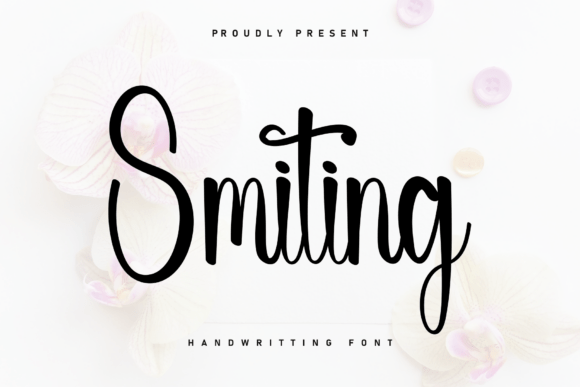
Smiting: The Handwritten Font That Feels Like a Confident Signature
Smiting isn’t just another script font—it’s the kind of typeface that makes people pause, smile, and think, “Yes, that’s exactly the tone I’ve been trying to nail.” Designed to look like it was drawn with a bold marker—steady hand, relaxed pressure, subtle line variation—it carries an effortless blend of luxury and casual charm. It doesn’t shout. It leans in. And because of that, it works where many handwritten fonts fail: in real projects with real stakes.
Where Smiting Fits Naturally (and Why It Stands Out)
Think about the last time you saw a wedding invitation that felt both elevated and warm—not stiff, not sloppy, but *human*. Smiting excels there. Its rhythm is loose enough to feel personal, yet consistent enough to hold up across full names, monograms, or even short quotes on vellum sleeves. It’s often chosen for boutique stationery studios precisely because it adds quiet confidence without demanding attention.
Fashion brands use Smiting when they want their logo or campaign tagline to suggest craftsmanship—not mass production. A sustainable activewear label, for example, might pair Smiting with clean sans-serif body text to say, “We move with intention, not noise.” It’s sporty in spirit (think chalkboard-style event signage at a yoga retreat or festival merch), but never juvenile. That balance is rare—and intentional.
Lookbooks benefit especially. When designers showcase seasonal collections, Smiting adds tactile warmth to product captions or section headers—like a stylist jotting notes beside a mood board. It softens the digital edge without sacrificing polish. One indie knitwear brand reported higher engagement on Instagram carousels where Smiting appeared in overlay text: followers commented that the typography “felt like the clothes looked—soft, considered, and quietly luxurious.”
Real People, Real Projects: Who Uses Smiting—and How
Creative freelancers reach for Smiting when clients ask for “elegant but not formal” branding—especially for wellness coaches, ceramicists, or floral designers. It helps position services as grounded and trustworthy, not distant or overly curated. One designer shared how she used Smiting for a client’s business card header, then echoed its stroke weight in custom-drawn icons. The result? A cohesive identity that felt handmade from start to finish—even though it scaled flawlessly across print and web.
Small-batch makers (candle makers, small-batch coffee roasters, natural skincare lines) love how Smiting bridges artisanal authenticity and modern appeal. On a matte black candle label, Smiting in gold foil reads as indulgent; on recycled kraft packaging, the same font feels earthy and sincere. It adapts—not by changing shape, but by how it’s paired and applied. That versatility saves time during mockup rounds.
Marketing teams at lifestyle brands deploy Smiting for limited-time campaigns: holiday promos, pop-up shop banners, or email subject lines meant to stand out in crowded inboxes. Because it’s highly legible at medium sizes (unlike ultra-thin or overly connected scripts), it performs well on mobile previews—no squinting, no misreading “&” as “a.” One DTC sleep brand A/B tested two versions of a Black Friday banner: one with Smiting for the offer headline (“25% Off—Sweet Dreams Start Here”), one with a generic brush script. Click-throughs were 18% higher with Smiting—likely due to its clarity and approachable authority.
What to Keep in Mind Before You Use Smiting
Smiting shines brightest when it has room to breathe. It’s not built for dense paragraphs or tiny footnotes. Its strength lies in short, impactful phrases: headlines, logos, quotes, labels, invitations. If your project needs body text, pair it thoughtfully—clean, neutral sans-serifs (like Inter, Poppins, or Montserrat) are ideal companions. Avoid competing scripts or overly decorative fonts nearby; Smiting doesn’t need backup singers.
Consider contrast carefully. Because it mimics marker ink, Smiting gains presence against light or mid-tone backgrounds—but can fade on busy textures or low-contrast gradients. Test it early on your intended surface: a textured paper stock may mute its line variation, while crisp white vinyl will highlight every confident stroke. Also note that Smiting includes standard OpenType features (ligatures, alternates), so if you’re using design software that supports them (like Adobe Illustrator or Affinity Designer), enabling stylistic sets can add subtle nuance—like swapping a rounded “g” for a more angular version to match a brand’s sharper personality.
It’s also worth remembering that “handwritten” doesn’t mean “imprecise.” Smiting is meticulously engineered for consistency. Letters align cleanly on baseline and x-height, spacing is optimized for readability, and kerning pairs are refined—not guessed. That means it scales reliably from a 12-pt caption on a product tag to a 200-pt mural headline. You get the soul of handwriting without the risk of uneven rhythm or awkward collisions.
When Smiting Might Not Be the Right Fit
If your project demands strict formality—think law firm letterhead, academic journal titles, or government reports—Smiting’s relaxed energy could unintentionally undercut seriousness. Similarly, highly technical or data-driven contexts (infographics with dense stats, engineering schematics, coding documentation) benefit from fonts prioritizing neutrality and precision over expressiveness.
And while Smiting handles most Latin-based languages well, check language support if you’re designing for multilingual audiences. It covers Western European accents thoroughly, but extended Cyrillic, Greek, or Vietnamese characters aren’t included in the standard package—so global campaigns may require fallback planning.
Small Choices, Big Impact
Typography is rarely about “correctness.” It’s about resonance. Smiting resonates because it mirrors how people actually write when they’re focused, calm, and present—not rushed, not performative, but sure. That’s why it shows up on a handmade soap label in Portland, a bridal suite sign in Lisbon, a capsule collection lookbook in Seoul, and a wellness retreat schedule pinned to a corkboard in Melbourne.
You don’t need to overthink it. Ask yourself: Does this need to feel human first? Does it benefit from quiet confidence instead of loud flair? Is elegance here meant to comfort—not impress? If yes, Smiting isn’t just appropriate. It’s quietly, unmistakably right.