Masking Tape Note: A Handwritten Font That Feels Like a Thought Jotted Down
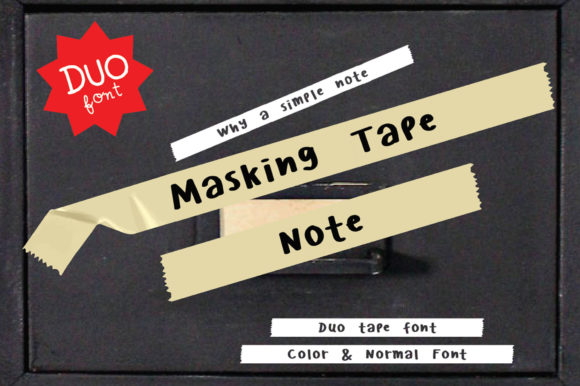
Masking Tape Note isn’t designed to dominate headlines or command attention through polish. Instead, it arrives quietly—like a well-worn notebook left open on a desk—carrying the warmth and slight imperfection of real handwriting. It’s a single-weight, all-caps, handwritten display font built from natural strokes, subtle inconsistencies, and gentle irregularities. There are no alternate glyphs, no stylistic sets, no ligatures. Just one cohesive, unfiltered voice: the kind you’d use to label a jar, sketch a quick concept, or write a reminder on a piece of torn tape.
What Makes Masking Tape Note Distinctive—Without Trying Too Hard
At its core, Masking Tape Note is defined by restraint. Its characters avoid uniform spacing, consistent stroke weight, or rigid alignment—choices that would undermine its authenticity. Letters sit at slightly varying baselines; some “A”s lean left, others settle more upright; the “O” isn’t a perfect circle but a soft, hand-drawn loop. These aren’t flaws—they’re features calibrated to mirror how people actually write with marker or pen on masking tape: quickly, intuitively, without overthinking.
This deliberate looseness gives Masking Tape Note a rare quality among handwritten fonts: legibility without sterility. Unlike many script fonts that sacrifice clarity for flourish, Masking Tape Note remains highly readable at medium sizes (24–48 pt), especially against clean backgrounds. Its uppercase-only structure adds to its utility in short-form contexts—labels, signage, packaging headers, slide titles—where immediate recognition matters more than paragraph flow.
Where It Performs Best—And Where It Doesn’t Pretend To
Masking Tape Note excels in projects where tone and texture matter as much as message. Think product packaging for small-batch food brands, workshop posters for community makerspaces, Instagram story text overlays for educators explaining a hands-on technique, or custom labels for handmade ceramics. In each case, the font supports—not overshadows—the subject. It signals approachability, craft, and human involvement without resorting to clichéd “rustic” textures or forced nostalgia.
It’s less suited for body copy, long-form editorial layouts, or interfaces requiring precise typographic hierarchy. You won’t find lowercase variants, numerals with tabular alignment, or punctuation optimized for dense text. That’s not a shortcoming—it’s a boundary. Masking Tape Note was never intended to replace Helvetica or Georgia. It fills a narrow, intentional niche: the visual equivalent of a confident, off-the-cuff annotation.
Usability and Integration in Real Workflows
As a standard OpenType font (.otf), Masking Tape Note installs and behaves predictably across Adobe Creative Cloud apps, Affinity Suite, Figma (via desktop plugin or webfont embedding), and most modern design tools. Kerning is manually tuned—not algorithmically generated—so letter pairs like “TA”, “NE”, and “OT” sit comfortably without awkward gaps. That consistency makes it reliable for rapid iteration: once you’ve tested spacing at your intended size, you can trust it across variations.
For developers embedding it via CSS, it works cleanly with @font-face declarations and performs well when served as a self-hosted file. Web use is practical for short headings or callouts—but avoid loading it solely for paragraph text, given its lack of lowercase and limited character set (no diacritics, minimal symbols beyond basic punctuation).
Audience Fit: Who Gains the Most From This Font?
Freelance designers building brand identities for local artisans often reach for Masking Tape Note when clients want something tactile and unpretentious—something that says “we made this ourselves” without saying it literally. Educators creating printable classroom resources appreciate how it adds visual warmth to vocabulary cards or lab instructions without distracting from content. Small business owners updating their social media templates use it to differentiate promotional posts from algorithmically generic feeds.
Bloggers writing about sustainability, DIY culture, or analog workflows find it reinforces thematic cohesion—especially when paired with photography of physical materials (paper, wood, fabric). Similarly, podcasters launching limited-run merch (stickers, tote bags, enamel pins) rely on its instant recognizability at small scales. Its strength lies not in versatility across *all* uses, but in resonance within *specific* ones.
Practical Considerations Before You Commit
- Check licensing scope: The standard license covers desktop and web use for most small-to-midsize projects, but verify terms if deploying in SaaS dashboards, mobile apps, or high-traffic e-commerce banners.
- Pair intentionally: It pairs best with neutral sans-serifs (e.g., Inter, Lato, or even system fonts like -apple-system) or modest serifs (Cormorant Garamond, Literata). Avoid competing handwritten or distressed fonts nearby—they’ll muddy the tone.
- Test contrast rigorously: While highly legible on light backgrounds, its low-contrast strokes can fade on busy imagery or dark mode interfaces. Always preview over actual background textures or photos used in final output.
- Respect its limits: If your project needs multilingual support, dynamic text scaling, or responsive typography systems, Masking Tape Note should serve only accent roles—not structural ones.
Long-Term Value: Why It Stays Useful Over Time
Few fonts age as gracefully as those rooted in observable human behavior—and Masking Tape Note draws directly from that well. Trends in digital design cycle quickly: glass morphism fades, neumorphism recedes, gradient overload loses impact. But the visual language of hand-applied labeling—whether on a vintage workshop wall or a modern studio shelf—remains culturally legible. That timelessness translates into reuse value: a logo lockup using Masking Tape Note today will likely still feel intentional and grounded five years from now.
It also avoids dependency on external assets. Unlike variable fonts requiring complex implementation or webfonts needing CDN coordination, Masking Tape Note delivers its effect with minimal overhead. No JavaScript, no fallback gymnastics—just clean, direct expression.
A Final Observation From Practical Use
In dozens of client projects spanning branding, publishing, and digital product work, Masking Tape Note has proven most valuable when treated as a *deliberate choice*, not a default. One designer used it exclusively for ingredient labels on a line of organic herbal teas—reinforcing transparency and care without leaning into wellness clichés. Another applied it sparingly to chapter dividers in a print zine about urban gardening, letting the font’s slight asymmetry echo the irregular growth patterns of plants. In both cases, the font didn’t carry the concept—it quietly held space for it.
If your work involves communicating authenticity, process, or materiality—and if your audience responds to cues that feel human-scaled rather than algorithmically optimized—then Masking Tape Note earns serious consideration. It won’t solve every typographic challenge. But for the right moment, in the right context, it offers something increasingly rare: handwriting that doesn’t try to be anything other than itself.