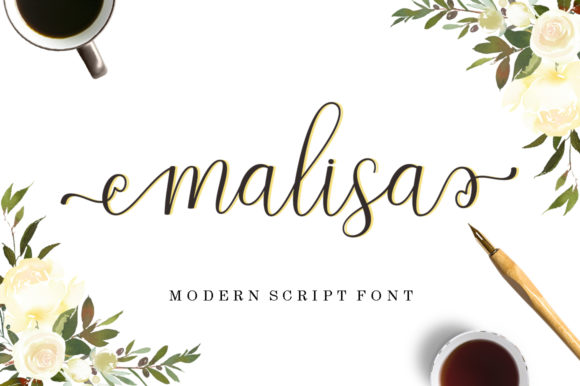
Malisa: A Light Handwritten Font with Refined Simplicity
Malisa stands out in the crowded landscape of handwritten typefaces—not through exaggerated flourishes or forced personality, but through quiet confidence. It’s a light, open, and rhythmically consistent script font designed for clarity and warmth. Unlike many display-oriented scripts that sacrifice legibility for visual impact, Malisa maintains readability at moderate sizes while retaining the organic flow of natural handwriting. That balance—between authenticity and utility—is what makes it worth serious consideration for professionals who need expressive typography without compromising function.
What Sets Malisa Apart Visually and Functionally
At its core, Malisa is built on subtle variation: slight shifts in stroke weight, gentle tapering at terminals, and carefully calibrated spacing between letters. Its lowercase forms have soft entry and exit strokes, avoiding sharp angles or abrupt stops. Uppercase characters are proportionally balanced—not oversized or overly decorative—so they integrate smoothly into mixed-case settings like headlines, pull quotes, or branded stationery. The font includes standard Latin characters, numerals, and basic punctuation, with OpenType features such as ligatures and alternate glyphs that enhance typographic nuance without requiring deep technical knowledge.
One practical strength is its light weight. This isn’t just an aesthetic choice—it means Malisa performs well in contexts where visual hierarchy matters. Pair it with a clean sans serif (like Inter, Lato, or Montserrat) for contrast, and it creates immediate distinction: the sans handles information, while Malisa conveys voice. That pairing works reliably across digital and print environments—from email headers and social media graphics to product packaging and workshop handouts.
Real-World Use Cases and Performance
Malisa excels where tone and approachability matter more than formality. A freelance educator might use it for course welcome emails or downloadable worksheets—its lightness feels inviting, not childish. A small-batch candle brand could apply it to jar labels or thank-you cards, reinforcing craftsmanship without leaning into clichéd “handmade” tropes. Bloggers writing about wellness or creative process often find Malisa fits naturally in featured quote graphics or section dividers—adding texture without competing with body text.
In practice, Malisa scales predictably. At 24–36px, it reads cleanly on desktop and mobile screens. At 14–18px, it remains legible in tight layouts like newsletter sidebars or app UI elements—though extended paragraph use isn’t advisable, given its script nature. Print output is consistently crisp: no hinting issues, no glyph distortion, even at smaller point sizes used in business cards or letterhead. Test prints on uncoated paper show its strokes hold shape well, with no unintended bleeding or thinning.
Quality, Consistency, and Workflow Integration
Malisa ships as a well-structured variable font or static OTF/TTF files, depending on the source. The variable version allows fine-tuning of weight and width—a rare flexibility for a handwritten face—making it adaptable across responsive design systems. Kerning pairs are thoughtfully adjusted, reducing manual corrections in design tools like Figma or Adobe Illustrator. In web projects using @font-face, load times remain low due to efficient glyph sets and modest file size (~80–110 KB).
Consistency is one of Malisa’s quieter strengths. Many script fonts introduce irregular spacing or unpredictable baseline alignment, leading to uneven line heights or awkward line breaks. Malisa avoids this: its metrics are stable, and vertical rhythm stays reliable across paragraphs and multi-line headings. Designers report fewer last-minute adjustments when using Malisa in layout-heavy projects—fewer “why does this word look cramped?” moments, and more time spent refining content and structure.
Who Benefits Most—and When It Might Fall Short
Malisa suits professionals who value intentionality over ornamentation. Entrepreneurs launching service-based businesses—coaching, consulting, design studios—often choose it to signal empathy and individuality without seeming unpolished. Marketers building brand guidelines appreciate how easily it complements neutral palettes and photography-driven layouts. Educators and creators publishing digital workbooks or printable resources find its lightness translates well to PDFs viewed on tablets or printed at home.
That said, Malisa isn’t universal. It lacks extended language support beyond Western European languages, so multilingual projects requiring Cyrillic, Greek, or diacritical-rich Vietnamese or Turkish text will need fallback solutions. It also doesn’t include stylistic sets for bold or black weights—so if your project demands strong visual contrast *within* the script itself (e.g., bolded keywords inside a handwritten sentence), you’ll need to simulate weight or switch fonts. And while its lightness is a strength, it can recede in noisy visual environments—like overlaid on busy background images—unless paired with sufficient contrast or subtle drop shadows.
Practical Recommendations for Getting Started
Start simple: use Malisa for one high-impact element per layout. A headline above a hero image. A short tagline beneath a logo. A signature-style credit line in a presentation deck. This lets its character shine without overwhelming the composition. Avoid stacking multiple script fonts—Malisa works best when it’s the only handwritten voice in the mix.
For web use, define clear fallbacks. A CSS stack like font-family: "Malisa", "Segoe Script", cursive; ensures graceful degradation. In branding, test how Malisa behaves across touchpoints: Does it retain warmth on a laser-printed invoice? Does it stay legible on a 16px mobile menu item? These aren’t theoretical concerns—they’re the difference between a font that supports your message and one that distracts from it.
If you’re evaluating Malisa alongside alternatives—say, Pacifico, Dancing Script, or Alex Brush—look beyond first impressions. Compare x-height consistency, spacing behavior in all-caps settings, and how each handles numbers in pricing or dates. Malisa may not have the widest stylistic range, but its reliability in mid-to-light applications gives it staying power across seasons and campaigns.
A Font That Supports, Not Dominates
Typography choices communicate before a single word is read. Malisa communicates ease, sincerity, and care—without shouting. It doesn’t try to be everything; instead, it fulfills a specific, well-defined role: lending human warmth to thoughtful communication. That focus makes it durable—not trendy, not fleeting. For professionals balancing aesthetics with audience needs, Malisa offers a pragmatic kind of elegance: one that serves the message first, and the designer second.