Kawai Friendship: A Handwritten Font with Distinctive Character and Purpose
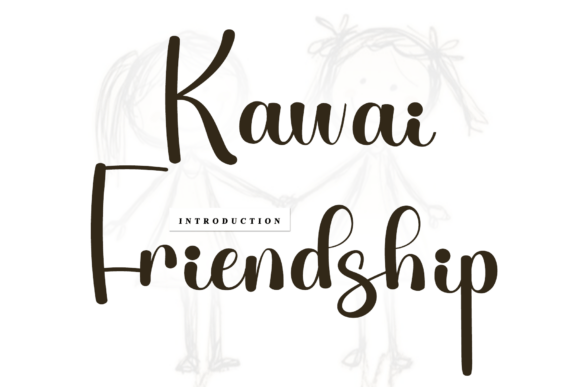
Kawai Friendship is a carefully crafted handwritten font designed to evoke warmth, sincerity, and approachability. Unlike many script fonts that prioritize flourish over function—or legibility over personality—Kawai Friendship strikes a consistent balance. Each glyph features subtle variations in stroke weight, organic entry and exit terminals, and gentle irregularities that mirror natural pen-on-paper motion. These details aren’t arbitrary; they’re intentional choices that give the typeface its “lovely and timeless” quality without sacrificing clarity at moderate sizes.
What Sets Kawai Friendship Apart from Other Handwritten Fonts
Not all handwritten fonts serve the same purpose—and not all achieve authenticity convincingly. Some lean heavily into calligraphic drama, with exaggerated swashes and tight spacing better suited for formal invitations than modern branding. Others adopt a casual, almost doodle-like looseness that risks appearing unpolished in professional contexts. Kawai Friendship occupies a thoughtful middle ground: it feels personal and human, yet remains structured enough to support cohesive visual systems.
Its lowercase a, g, and y feature open, friendly shapes that improve readability in short-form applications like social media graphics or product labels. Uppercase letters maintain presence without dominance—ideal when pairing with neutral sans-serif companions in logo lockups. The spacing (both letter- and word-spacing) is calibrated for even rhythm, avoiding the crowded or scattered appearance common in less-refined handwritten options.
Where Kawai Friendship Excels—and Where It Has Limits
Kawai Friendship shines in contexts where emotional resonance matters as much as visual identity. It’s especially effective for:
- Branding for wellness studios, boutique bakeries, handmade goods, or children’s products—where warmth and trust are central to audience perception;
- Short-form quotes on Instagram or Pinterest, where its expressive character draws attention without overwhelming the message;
- Logo treatments that pair the font with clean supporting typography (e.g., a crisp geometric sans for taglines or web navigation);
- Printed packaging or stationery where tactile authenticity supports brand storytelling.
That said, Kawai Friendship isn’t optimized for every use case. Its expressive nature makes it less suitable for body text, long paragraphs, or interfaces requiring high scannability—such as websites with dense content, technical documentation, or data dashboards. It also performs best at sizes of 16px and above in digital settings; smaller implementations may lose nuance or reduce legibility, particularly on lower-resolution screens.
Another practical consideration: Kawai Friendship is a single-weight, single-style font. It does not include bold, italic, or condensed variants. Designers needing typographic hierarchy within the same family—say, for headings versus subheadings—will need to supplement with a compatible secondary typeface. This isn’t a flaw, but rather a design constraint worth acknowledging early in the selection process.
Comparing Approaches: When to Choose Kawai Friendship Over Alternatives
Choosing a handwritten font often involves weighing aesthetic intent against functional requirements. Kawai Friendship stands out when the priority is conveying sincerity—not just style. Consider how it compares across common decision points:
Legibility vs. Expressiveness
Some users gravitate toward highly stylized scripts for their visual impact, only to find them difficult to read in context. Kawai Friendship avoids that tradeoff by prioritizing clear letterforms first, then layering in expressive detail. If your project requires immediate recognition—like a café sign viewed from across the street or a product name on a small jar label—its balanced construction offers more reliability than fonts with tighter counters or overlapping strokes.
Timelessness vs. Trend Sensitivity
Trends in handwritten typography shift quickly: today’s “authentic brush script” can feel dated in two years if it leans too hard into a specific tool (e.g., marker, chalk, or watercolor texture). Kawai Friendship avoids trend dependency by focusing on foundational handwriting principles—consistent pressure variation, natural flow, and restrained ornamentation. That gives it staying power across seasons and platforms.
Integration With Broader Design Systems
A key strength of Kawai Friendship is its adaptability in combination. Because its proportions and x-height align well with many contemporary sans-serifs and low-contrast serifs, it pairs intuitively with fonts like Inter, Lora, or Poppins. This compatibility reduces friction during implementation—especially for non-designers managing brand assets or updating templates in tools like Canva or Figma. Fonts with extreme contrast or idiosyncratic spacing often require more manual adjustment to sit comfortably beside supporting type.
Realistic Use Cases and Practical Comparisons
Imagine designing a logo for a local florist launching an online shop. You want something that feels personal—not corporate—but still conveys care and craftsmanship. Using Kawai Friendship for the business name, paired with a light-weight sans-serif for the tagline (“Seasonal Blooms Delivered Weekly”), creates visual contrast while maintaining tonal consistency. In contrast, a more ornate script might overwhelm the accompanying text or appear overly formal for a small-scale operation.
Now consider a wellness app interface. A greeting screen with “Welcome back, Maya” in Kawai Friendship adds a gentle, human touch—appropriate for a moment of re-engagement. But attempting to use the same font for navigation labels (“Dashboard,” “Journal,” “Settings”) would compromise usability. Here, the smart choice is reserving Kawai Friendship for select moments of emphasis and relying on a highly legible system font elsewhere.
Similarly, for printed wedding stationery, Kawai Friendship works beautifully for names and dates—but likely not for full invitation copy. A complementary serif (like Merriweather or Playfair Display) handles longer passages with grace, letting Kawai Friendship anchor the most emotionally resonant elements.
Making an Informed Choice
Selecting Kawai Friendship shouldn’t be about chasing a particular look—it should align with what your project needs to communicate and where it will live. Ask yourself:
- Is emotional tone as important as visual clarity? If yes, Kawai Friendship’s expressive yet legible nature becomes a strong candidate.
- Will this font appear primarily in short, high-impact placements—or in extended reading environments? Its strengths lie in the former.
- Do you have flexibility to pair it thoughtfully with other typefaces? Its single-weight nature means successful implementation often depends on smart pairing decisions.
- Does your audience respond to approachability and craft—or do they expect precision, authority, or neutrality? Kawai Friendship supports the former far more readily than the latter.
If those questions point toward warmth, authenticity, and selective emphasis, Kawai Friendship is worth serious consideration. If your goals center on scalability across complex layouts, multilingual support, or typographic versatility within one family, you may benefit from exploring broader font systems—even if they lack the same handwritten charm.
Ultimately, Kawai Friendship is a tool with clear intent and quiet confidence. It doesn’t try to do everything. Instead, it does a few things very well: inviting attention, reinforcing sincerity, and lending humanity to carefully considered design choices. When matched to the right context—and used with intention—it delivers value that extends beyond aesthetics into real audience connection.