Said the Owl
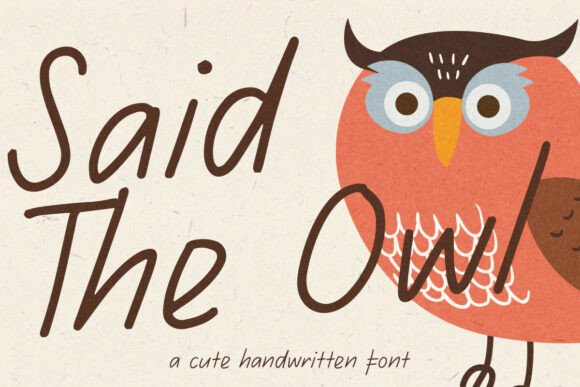
There’s a quiet magic in handwriting that feels alive—slight variations in pressure, gentle curves that breathe, letters that lean just enough to suggest warmth and intention. Said the Owl captures that feeling with remarkable sincerity: a cute handwritten font designed not for flash, but for heartfelt storytelling. Its slender, organic letterforms—tall ascenders, soft joins, and a storybook-sketch soul—invite readers into a world where imagination feels safe and words carry kindness. It’s no surprise creators reach for Said the Owl when building boutique nursery branding, designing handmade greeting cards, illustrating indie children’s books, or crafting cottage-core social media overlays that resonate emotionally.
It’s Not Just “Cute”—It’s Context-Specific
One of the most common oversights is treating Said the Owl like a general-purpose script font. It isn’t. Its airy rhythm and approachable weight make it exceptionally legible at medium sizes—but only in the right settings. When used for body text in long-form web articles or dense PDF handouts, its delicate strokes can blur or fatigue the eye. Similarly, scaling it too small (under 16px on screen or 10pt in print) risks losing its expressive charm entirely. That tall ascender? Lovely in a headline. Nearly invisible in a caption.
Instead, use Said the Owl where its strengths shine: short, evocative phrases—book titles, product names, quote overlays, invitation headers, or packaging accents. A better approach? Pair it intentionally: set Said the Owl for your greeting card’s sentiment (“You’re my favorite person”), then choose a clean, neutral sans-serif (like Poppins or Lato) for the sender’s name and date. This contrast honors both personality and practicality.
Don’t Assume Licensing Covers All Your Uses
Licensing confusion trips up many creators—especially freelancers designing for clients or small business owners expanding their product lines. The standard desktop license for Said the Owl permits use in static designs: printed books, physical cards, social media graphics, and branded merchandise like mugs or tote bags. But it does not cover web embedding (via @font-face), app interfaces, or digital templates sold on marketplaces—unless you’ve purchased an extended license.
A real-world example: A blogger created a printable “Storytime Planner” using Said the Owl, then uploaded it to Etsy. Without verifying the license terms, she unknowingly violated usage rights—and later received a polite but firm notice from the foundry. The fix was simple—she upgraded her license—but the delay cost her two weeks of sales.
Before downloading or purchasing, always check the license details directly from the official source. Look for clear language around “digital templates,” “SaaS platforms,” and “client deliverables.” If you’re a freelancer, clarify early whether your client needs their own license—or if your studio license includes redistribution rights.
Handwritten ≠ Unstructured—Spacing Matters More Than You Think
Because Said the Owl mimics natural handwriting, some assume tight tracking or uneven line spacing won’t matter. In practice, they do—especially in multi-line layouts. Its unrefined charm works because it’s *intentionally* unrefined—not haphazard. Overly tight letter spacing compresses its airy rhythm; excessive leading can break visual cohesion in short quotes.
Try this instead: In design software, start with the font’s default metrics, then adjust tracking in tiny increments (+10 to +30 for headlines, –5 to +15 for subheads). For line height, aim for 1.4–1.6× the font size in print, and 1.5–1.7× on screen. Test readability by stepping back three feet—or viewing on a phone. If the phrase feels “crowded” or “floaty,” revisit spacing before finalizing.
Beware the “Free Font” Trap
You might find lookalikes labeled “Said the Owl free download” or “Said the Owl Google Fonts alternative.” These are almost always unauthorized copies—often stripped of OpenType features, poorly spaced, or embedded with malware. Worse, they lack the subtle alternates and ligatures built into the authentic version (like the charming “&” or contextual ‘a’/‘o’ variants), which add depth to longer phrases.
Using a counterfeit version doesn’t just risk legal exposure—it diminishes the very quality you sought: authenticity. A genuine Said the Owl file includes stylistic sets, multilingual support (including accented characters for French, Spanish, and German), and consistent kerning pairs. Free knockoffs rarely do.
The smarter move? Purchase directly from the designer’s site or trusted platforms like Creative Market or MyFonts. Most offer previews, test files, and responsive support—so you know exactly what you’re getting before committing.
Test Before You Commit—Especially for Print
Screen rendering flatters many handwritten fonts. What looks warm and whimsical on your monitor may appear faint or inconsistent when printed—particularly on textured paper or with lower-DPI printers. One illustrator discovered this the hard way when her nursery brand’s business cards came back with Said the Owl looking washed out on kraft stock. The issue wasn’t the font—it was ink density and paper absorbency.
Always order a physical proof first. Print a test sheet at home using your intended paper type and printer settings. Check for stroke clarity, contrast balance, and how well ascenders hold shape at your target size. If printing professionally, share your font file with the printer and ask for a press proof—not just a PDF preview.
Think Beyond Aesthetics—Consider Emotional Alignment
Finally, avoid choosing Said the Owl purely on visual appeal. Ask: Does its gentle wonder match the tone of your project? It excels in nurturing, imaginative, or nostalgic contexts—but may feel incongruous in bold, tech-forward, or highly formal messaging. A children’s literacy nonprofit using Said the Owl for their campaign materials landed beautifully. A cybersecurity startup trying the same font for their newsletter? Confused readers and diluted credibility.
Your font choice communicates before a single word is read. Let Said the Owl speak for stories, care, and quiet joy—not urgency, authority, or precision. When it aligns, the result feels inevitable. When it doesn’t, even perfect execution falls short.
So take a breath. Preview thoughtfully. License honestly. Space intentionally. Print carefully. And let Said the Owl do what it does best—not as decoration, but as quiet, confident voice for the things that matter most.