Retriever: A Handwritten Font That Balances Charm and Clarity
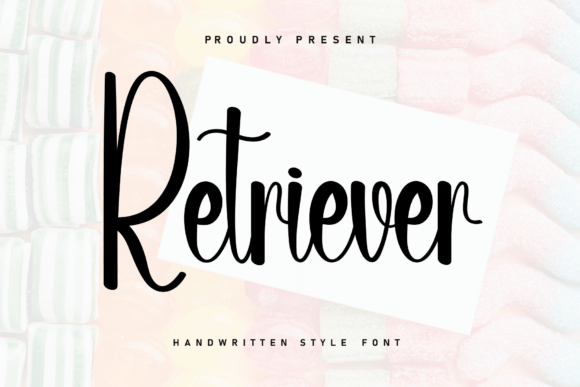
Retriever stands out in the crowded landscape of handwritten typefaces—not by chasing trendiness, but by delivering consistent warmth and legibility. It’s not a script designed for dramatic flourishes or maximalist personality; instead, Retriever is built around subtle rhythm, gentle baseline variation, and thoughtful spacing. Its characters appear to “dance along the baseline,” as its description notes—but that movement is measured, never erratic. This restraint makes Retriever unusually versatile for a handwritten font, especially when applied beyond decorative accents.
What Makes Retriever Distinctive—Beyond Aesthetics
At first glance, Retriever reads as approachable and sincere—a quality rooted in its construction. Unlike many handwritten fonts that rely on heavy alternates or randomized glyphs to simulate authenticity, Retriever achieves naturalness through deliberate, consistent letterforms. Each character maintains a soft, rounded structure with modest contrast between thick and thin strokes. The lowercase a, e, and g follow classic single-story forms, improving readability at smaller sizes. Uppercase letters avoid exaggerated swashes, keeping hierarchy clear in headings or logos.
The baseline variation is present but restrained: ascenders rise gently, descenders taper without sharp hooks, and word spacing remains even across varied character combinations. This contributes directly to Retriever’s reliability in real-world settings—where inconsistent tracking or awkward kerning can undermine even the most charming design.
Practical Performance Across Mediums
Retriever performs well in both digital and print contexts, provided usage aligns with its strengths. At 16–24px on screen, it holds up effectively in hero sections, email headers, or blog post titles—especially against light backgrounds with sufficient contrast. Its open counters and generous x-height support readability without sacrificing character. In print, it works cleanly at 14–18pt for invitations, packaging copy, or editorial subheads, though extended body text (e.g., full-page articles) isn’t its ideal use case.
One practical observation: Retriever includes standard Latin characters, numerals, and basic punctuation, but lacks extended language support (e.g., Central/Eastern European diacritics or Cyrillic). Users working with multilingual content should verify coverage before committing to large-scale implementation. Also, while it offers OpenType features like ligatures and stylistic alternates, these are subtle—designed to refine tone rather than transform functionality.
Who Benefits Most—and Where It Fits Naturally
Retriever serves creators who need handwritten warmth without compromising professionalism. Small business owners crafting brand identities—especially in wellness, education, artisan goods, or boutique services—find it effective for logotypes, signage, and social media visuals. Its balance of friendliness and polish avoids the overly casual impression some script fonts convey, making it appropriate for client-facing materials where trust and approachability matter.
Bloggers and educators use Retriever to soften academic or instructional content—adding visual relief in section headers, pull quotes, or worksheet titles without distracting from substance. Freelance designers integrate it into presentation decks or pitch documents to signal thoughtfulness and human-centered thinking, particularly when paired with a neutral sans-serif (like Inter or Lato) for body text.
Marketers deploying Retriever in email campaigns report improved engagement on subject lines and CTA buttons—particularly among audiences aged 30–50. The font’s familiarity (evoking pen-on-paper authenticity) appears to reinforce message sincerity, though results vary depending on audience expectations and overall layout discipline.
Strengths in Context—Not Just Isolation
Retriever’s greatest strength lies in its contextual reliability. Many handwritten fonts excel in isolation—on a poster, a single Instagram graphic—but falter when scaled across touchpoints. Retriever maintains cohesion across web, email, print, and even basic SVG exports. Its weight distribution allows clean rendering on low-DPI screens, and its vector outlines scale without visible distortion.
It also resists visual fatigue. Because its rhythm is steady—not jagged or over-ornamented—it doesn’t compete with imagery or dense layouts. In side-by-side testing with more energetic scripts (e.g., Pacifico or Great Vibes), Retriever consistently supported longer attention spans in user feedback sessions, particularly when used for short-form messaging.
Realistic Considerations and Limitations
No font is universally optimal, and Retriever has boundaries worth acknowledging. It’s not suited for high-contrast branding requiring bold differentiation (think tech startups aiming for disruptive energy). Its sweetness leans toward warmth over authority—so legal firms or financial institutions may find it too gentle for primary identity use, though it could work well in supporting communications (e.g., internal newsletters or community outreach).
Also, while Retriever feels cohesive, it doesn’t include multiple weights. Designers accustomed to fine-tuning hierarchy via bold/medium/light variants will need to rely on size, color, or pairing strategies instead. This isn’t a flaw—it’s a design decision aligned with its purpose—but it does shape workflow integration.
Finally, licensing clarity matters. Retriever is typically offered under standard desktop and web licenses, but users embedding it in SaaS platforms, mobile apps, or digital products should confirm usage rights with the foundry or distributor. Some versions restrict commercial redistribution or require extended licenses for large-scale deployments.
Pairing and Implementation Tips
Retriever pairs most effectively with clean, humanist sans-serifs. Avoid geometric or ultra-thin options, which can create tonal dissonance. Try it with:
- Inter or Manrope for UI and web interfaces—both offer excellent readability and complementary neutrality.
- Merriweather or Cormorant Garamond for editorial projects where serif contrast adds quiet sophistication.
- Work Sans or Source Sans Pro for presentations or reports needing accessible, professional contrast.
When implementing Retriever digitally, prioritize @font-face loading with fallbacks, and test across Chrome, Safari, and Firefox. On mobile, ensure line-height remains generous (1.4–1.6) to preserve its airy rhythm. For print, export PDF/X-4 with embedded fonts to prevent substitution.
A Thoughtful Tool, Not a Trend
Retriever earns its place not because it’s novel, but because it solves a specific, recurring need: how to introduce handwritten authenticity without sacrificing clarity or consistency. It doesn’t try to be everything—a display font, a text face, a multilingual system. Instead, it focuses on doing one thing well: offering warmth that reads clearly, scales reliably, and integrates smoothly into professional workflows.
For creators balancing aesthetic intention with functional demands, Retriever functions less like decoration and more like a calibrated instrument—subtle enough to recede when needed, expressive enough to elevate when appropriate. Its value emerges not in isolation, but across the dozens of small decisions designers and communicators make every day: which font signals care without pretense, which typeface supports meaning rather than obscuring it, and which tool quietly strengthens connection—without drawing attention to itself.