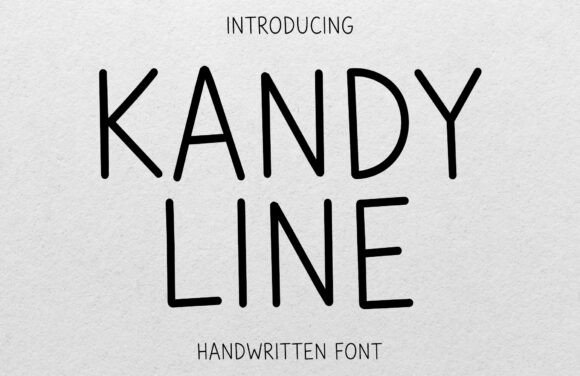
Kandy Line
Kandy Line isn’t just another handwritten font—it’s the kind of typeface that feels like a friendly, confident voice in your design. Clean but never stiff, playful but never childish, it strikes that rare balance where personality meets professionalism. Think of it as the handwritten font you’d choose when you want warmth and clarity to coexist—no forced quirkiness, no overworked flourishes, just smooth, intentional strokes that look effortlessly human.
Where Kandy Line Fits Naturally (and Why It Stands Out)
Unlike many script fonts that demand attention through exaggerated swashes or tight letter spacing, Kandy Line breathes. Its minimal line style and consistent rhythm make it highly legible—even at smaller sizes—while still carrying unmistakable character. That’s why it works so well across contexts where tone matters as much as readability: from a boutique coffee shop’s chalkboard-style Instagram post to a wellness coach’s downloadable meditation guide.
Branding That Feels Human, Not Hyped
Small businesses and solopreneurs often struggle to find branding fonts that feel personal without veering into “cutesy” territory. Kandy Line sidesteps that trap. A local florist might use it for their logo tagline (“Seasonal Blooms, Thoughtfully Grown”)—soft enough to reflect care, clean enough to suggest reliability. A freelance graphic designer could feature it on their portfolio site’s hero section (“Design with intention, not noise”)—giving warmth without sacrificing modernity. Because it includes both uppercase and lowercase characters—and avoids forced ligatures or overly connected letters—it scales gracefully from business cards to website headers.
Social Media That Connects, Not Competes
Scrolling fatigue is real. On platforms like Instagram or Pinterest, text-heavy graphics need to land quickly and feel authentic—not polished to the point of detachment. Kandy Line excels here. Try pairing it with muted earth tones or soft pastels for a quote graphic (“Your progress isn’t linear—and that’s okay”). Or use it in a Reel thumbnail overlay for a small-batch candle brand: “Hand-poured • Small-batch • Scent-led.” The font’s natural flow supports storytelling rather than interrupting it. And because its stroke weight stays even across characters, it holds up well when converted to PNG or placed over textured backgrounds.
Printed Moments That Feel Intentional
Invitations, greeting cards, and event signage benefit immensely from fonts that whisper “this was made for you,” not “this was generated in bulk.” Kandy Line delivers that quiet intentionality. A wedding couple choosing stationery might opt for it on their save-the-date (“Join us as we begin our next chapter”)—its gentle curves echoing handwritten vows, while its clarity ensures addresses and dates remain easy to read. Similarly, educators designing classroom posters (“Growth happens outside the comfort zone”) or therapists creating client handouts (“What if kindness started with your own thoughts?”) find it approachable without being juvenile.
Wearables and Merch With Quiet Confidence
T-shirt designs live or die by how well the typography translates to fabric. Too thin? It fades. Too ornate? It loses definition in print. Kandy Line sits comfortably in the middle: its strokes are substantial enough to hold up in screen printing or embroidery, yet light enough to avoid visual heaviness. A yoga studio’s merch line might feature “Breathe in. Show up.” across the chest; a book club’s limited-run tote could say “Currently reading: wonder, slowly.” The font’s relaxed posture invites connection—not performance.
Who Benefits Most—and How They Use It Differently
A freelance illustrator might layer Kandy Line over hand-drawn sketches to unify digital and analog textures. A nonprofit communications manager could use it to soften data-heavy annual reports—adding humanity to impact metrics. A food blogger may apply it to recipe cards (“Roasted carrots • maple • thyme • 25 minutes”) to evoke home-kitchen authenticity. Even developers building landing pages for creative tools sometimes reach for Kandy Line in hero sections—not as body copy, but as a tonal anchor that signals “this is for makers, not managers.”
Things to Keep in Mind Before You Use It
Kandy Line shines brightest when contrast and context support its strengths. It’s not designed for ultra-narrow columns or dense paragraphs—its charm lies in breathing room. If you’re setting long-form blog content or legal disclaimers, pair it with a neutral sans-serif (like Inter or Lato) for body text and reserve Kandy Line for headings, pull quotes, or callouts. Also, while its lowercase forms add versatility, some users report subtle inconsistency in baseline alignment across certain character combinations—so always preview full words, not just isolated letters, especially in logos.
It’s also worth noting: Kandy Line doesn’t include extensive language support beyond basic Latin characters (no accented letters for French, Spanish, or Eastern European languages out of the box). If your project targets multilingual audiences, check the character set before committing—or plan for graceful fallbacks.
When Simplicity Isn’t a Compromise—It’s the Strategy
In a landscape crowded with hyper-stylized fonts and AI-generated “handwritten” effects, Kandy Line stands out by refusing to overexplain itself. There are no hidden glyphs, no alternate swashes to toggle, no learning curve. What you see is what you get—and what you get is reliable, expressive, and quietly confident. It doesn’t try to be everything. It tries to be *right*—for the right moment, the right message, the right person holding the phone, scanning the shelf, or pausing mid-scroll.
That’s why designers return to it for projects where authenticity can’t be faked: a therapist’s website that puts visitors at ease before the first click; a sustainable skincare brand whose packaging whispers care instead of shouting claims; a student launching their first zine and needing type that feels like a conversation, not a presentation.
Kandy Line doesn’t solve every typographic challenge—but it solves a very specific, very common one: how to communicate warmth without losing clarity, playfulness without sacrificing polish, and humanity without leaning on clichés. And in a world that increasingly values intention over intensity, that’s not just useful. It’s essential.