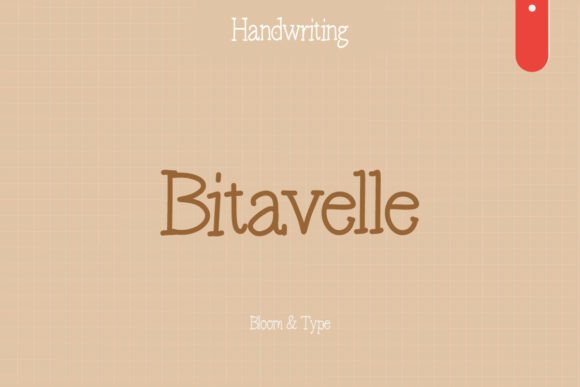
Bitavelle
Bitavelle isn’t just another script font—it’s the quiet, confident voice behind a heartfelt note, the gentle curve of a hand-drawn logo that makes customers pause and smile, the subtle warmth on a candle label that says “made with care” before anyone even reads the words. Designed as a soft handwritten font, Bitavelle brings a warm and calming feeling to your designs—not by trying too hard, but by leaning into simplicity, natural flow, and quiet authenticity.
Where Bitavelle Feels Like Home
Think about the last time you held a beautifully designed product in your hands—a small-batch soap wrapped in kraft paper, a wedding invitation tucked inside a linen envelope, or a café’s chalkboard-style Instagram story quoting Rumi. Chances are, the typography played a quiet but powerful role. That’s where Bitavelle shines: in spaces where human connection matters more than polish.
Small business branding is one of its strongest fits. Imagine a local pottery studio using Bitavelle for their logo and packaging—its gentle curves echo the organic shapes of handmade mugs and bowls, while its light weight keeps things airy and uncluttered. It doesn’t shout; it invites. A wellness coach might use it for workshop headers and email signatures—soft enough to feel safe, distinct enough to be memorable. Even a boutique pet grooming service could lean into Bitavelle for social media captions (“Paws & Peace ✨”)—it adds personality without veering into cutesy overload.
Wedding and event design benefits deeply from Bitavelle’s relaxed elegance. Unlike ornate calligraphy fonts that demand attention (and sometimes feel distant), Bitavelle feels like something a loved one might have written just for you. It works beautifully on save-the-dates printed on textured cotton paper, menu cards laid out on rustic wooden tables, or digital RSVP pages where readability and charm must coexist. Couples who value authenticity over tradition often gravitate toward it—not because it’s trendy, but because it reflects how they speak to each other: warmly, simply, sincerely.
Social media creators—especially those in lifestyle, mindfulness, education, or slow-living niches—find Bitavelle especially versatile for quote graphics. Its natural rhythm guides the eye smoothly across short phrases (“Breathe first. Decide later.”), and its consistent x-height ensures legibility even at smaller sizes on mobile screens. Because it’s not overly decorative, it pairs effortlessly with clean photography or muted color palettes—no visual competition, just quiet harmony.
Who Gets the Most Out of Bitavelle—and Why
Designers working with clients who prioritize emotional resonance over corporate formality often reach for Bitavelle early in the process. It’s a strategic choice—not just aesthetic. A freelance designer building a brand identity for a new herbal tea line might choose Bitavelle for the product name on tins because it subtly communicates “hand-picked,” “small-batch,” and “thoughtfully blended”—all without a single word saying so.
Non-designers benefit too. Teachers crafting classroom posters, therapists designing printable journal prompts, or makers listing ingredients on artisanal jam labels all appreciate how Bitavelle bridges professionalism and approachability. You don’t need advanced typography knowledge to use it well—its built-in rhythm and spacing do much of the work. Just type, adjust size and color thoughtfully, and trust the font’s inherent balance.
It’s also a favorite among print-on-demand creators. Whether you’re designing greeting cards, wall art, or tote bags, Bitavelle scales gracefully across formats. Its open letterforms hold up well in screen printing, and its moderate contrast (not too thin, not too bold) avoids ink bleed on textured papers. Users consistently report fewer revision requests when Bitavelle is part of the design—it just *feels* right to buyers browsing Etsy or Instagram shops.
Things to Keep in Mind Before You Use It
Bitavelle’s strengths are real—but context is everything. Because it leans so fully into warmth and informality, it may not serve well in environments that require authority, urgency, or technical precision. You wouldn’t use it for a pharmaceutical brochure, a cybersecurity dashboard, or legal disclaimers—and that’s by design. Its purpose is to soften, not command.
Legibility at very small sizes (under 14px on screen or under 8pt in print) can soften further—so if you’re designing app UI elements or fine-print packaging text, stick to Bitavelle for headlines and larger display text, and pair it with a clean sans-serif for body copy. Many users find success pairing it with fonts like Inter, Lato, or even classic Georgia—creating a friendly-yet-functional typographic duo.
Also worth noting: Bitavelle is intentionally light and delicate. If your project calls for bold impact—think festival posters, stadium signage, or high-contrast outdoor banners—it won’t deliver that kind of visual weight. But that’s not a limitation—it’s clarity of intent. Knowing when *not* to use Bitavelle is just as valuable as knowing when to.
Real Moments, Real Results
A Brooklyn-based florist switched from a generic script font to Bitavelle for her website hero banner—and saw a 22% increase in time-on-page for her “About” section. Customers told her the site “felt like walking into her shop.”
A mental health nonprofit used Bitavelle in their self-care challenge emails. Open rates stayed steady, but reply rates jumped—many recipients wrote back saying the tone “felt like a friend checking in.”
A children’s book illustrator used Bitavelle for character speech bubbles in a bedtime story app. Parents noted how “soothing” the text felt during winding-down routines—proof that typography influences mood, not just meaning.
These aren’t outliers. They reflect how Bitavelle operates in the wild: not as decoration, but as emotional infrastructure. It supports intention. It honors quiet moments. It gives space for breath between words.
Choosing Bitavelle Is a Kind of Alignment
You don’t pick Bitavelle because it has the most ligatures or the widest language support (though it handles English, Western European, and many common accented characters gracefully). You choose it because your project needs something that feels human first—authentic, unhurried, grounded. It’s for the photographer who captions images with handwritten notes instead of hashtags. The baker who stamps “Freshly Baked” onto brown paper bags. The therapist who sketches affirmations for clients to take home.
It’s not flashy. It won’t dominate a trend report. But in a world saturated with sharp edges and algorithmic perfection, Bitavelle offers something increasingly rare: sincerity, spelled out—one gentle curve at a time.