Angella: A Refined Calligraphy Font for Elegant, Legible Typography
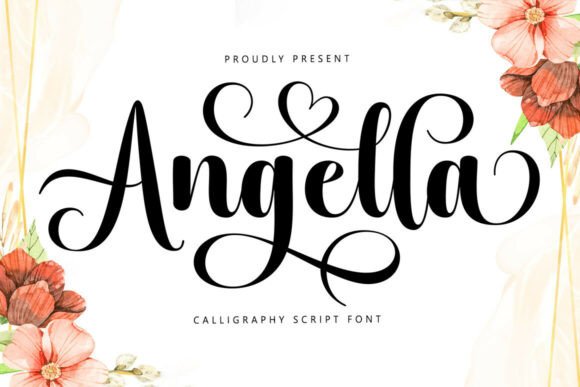
Angella stands out in the crowded landscape of script fonts—not through novelty or trend-chasing, but through disciplined craftsmanship. It’s a calligraphy-inspired typeface grounded in handwritten authenticity, yet refined for clarity and versatility. Unlike many decorative scripts that sacrifice legibility for flourish, Angella balances expressive strokes with consistent spacing, open counters, and thoughtful weight distribution. Its design philosophy centers on elegance without excess—making it especially valuable for professionals who need typographic sophistication *and* functional reliability.
What Makes Angella Distinctive
At its core, Angella is built from deliberate calligraphic movement—broad nib influence is visible in its contrast between thick downstrokes and fine hairlines—but it avoids the unevenness that can undermine readability at smaller sizes or in extended text. The lowercase ‘a’, ‘g’, and ‘e’ feature graceful entry and exit strokes that feel organic, not forced. Uppercase letters retain presence without dominance, supporting hierarchy rather than competing with it.
Its alternate characters aren’t ornamental add-ons; they’re context-aware refinements. For example, the swash ‘Q’ or flourished ‘y’ serve specific compositional roles—ideal for logos or headlines where a single letter carries visual weight. Ligatures like ‘fi’, ‘fl’, and ‘ct’ resolve collisions cleanly, while multilingual support (including Latin Extended-A and basic diacritics) extends usability beyond English-language projects without requiring workarounds.
Practical Strengths Across Real-World Applications
Legibility is Angella’s quiet strength. It performs well at 14–18 pt in printed stationery and remains discernible even at 10 pt in caption-heavy layouts—unusual for a script font. This reliability matters when designing wedding invitations where guests must parse names, dates, and venues quickly, or fashion lookbook captions where tone and clarity must coexist.
In branding contexts, Angella supports both recognition and resonance. A cosmetics line might use its delicate ‘S’ or looping ‘R’ in a monogram logo, then switch to standard glyphs for body copy on product labels—leveraging stylistic sets without disrupting typographic harmony. Its clean baseline alignment also means it pairs predictably with sans-serif or serif companions (e.g., Lora for body text, Inter for UI elements), reducing trial-and-error in layout.
For publishers and authors, Angella’s suitability extends beyond cover typography. Chapter headings in romance novels benefit from its sensual rhythm, while pull quotes in lifestyle magazines gain quiet authority. Even in digital use—such as email headers or social media banners—it renders consistently across modern browsers and operating systems, provided webfont formats (WOFF2) are properly implemented.
Who Benefits Most—and Where It Fits Best
Freelance designers working with boutique clients—especially in wedding planning, luxury retail, or independent publishing—find Angella efficient: it delivers high perceived value without demanding extensive customization. Small business owners launching a skincare brand or artisanal bakery can use it across touchpoints (logo, packaging, thank-you cards) while maintaining cohesion. Educators creating presentation handouts or curriculum materials appreciate its approachability—students read it easily, and instructors avoid misinterpretation of handwritten-style terms.
Bloggers and content creators targeting mature audiences (25–50) often choose Angella for newsletter headers or featured quote graphics. Its femininity reads as intentional, not stereotyped—supported by structural balance rather than exaggerated curves. That nuance helps avoid visual fatigue in repeated exposure, a common issue with overly stylized scripts.
Usability Considerations and Workflow Integration
Angella includes full punctuation, numerals, and OpenType features accessible via design software (Illustrator, InDesign, Affinity apps). Users should expect standard installation and activation—but note that accessing alternates and ligatures requires enabling OpenType features manually, not just selecting a “bold” or “italic” variant. This isn’t a limitation; it’s flexibility. Designers retain control over when and how flourishes appear, preventing accidental overuse.
For developers embedding Angella in web projects, variable font versions aren’t available—so pairing it with system-safe fallbacks (e.g., font-family: "Angella", "Segoe Script", cursive;) ensures graceful degradation. Licensing permits desktop, web, and app use under standard commercial terms, with no per-page or impression caps—a practical advantage for agencies managing multiple client sites.
Limitations Worth Acknowledging
Angella isn’t intended for dense editorial text or data-heavy interfaces. Its charm lies in selective application—not ubiquity. Attempting to set full paragraphs in Angella will compromise scannability and accessibility, particularly for readers with dyslexia or low vision. Similarly, its romantic tone may misalign with brands emphasizing technical precision (e.g., engineering firms or cybersecurity tools), where neutrality or authority takes priority.
While multilingual support covers major Western European languages, it doesn’t extend to Cyrillic, Greek, or Asian character sets. Projects requiring broader linguistic coverage will need supplemental fonts. Also, the absence of true italic variants (only stylistic alternates) means emphasis relies on weight shifts or contextual substitution—not slant-driven hierarchy.
Long-Term Value and Professional Fit
Fonts age differently. Some feel dated within months; others become quietly indispensable. Angella falls into the latter category—not because it’s trendy, but because its foundation is timeless: controlled calligraphic motion, balanced proportions, and restrained ornamentation. It avoids the visual noise common in algorithmically generated scripts, favoring human-informed spacing and stroke modulation.
Over time, users report growing confidence in its predictability. Once familiar with its alternates, a designer can rapidly iterate logo concepts or invitation suites without second-guessing legibility or tone. That efficiency compounds across projects—reducing revision cycles and strengthening client trust in typographic judgment.
If your work prioritizes emotional resonance alongside functional clarity—if you regularly design for moments that warrant sincerity, grace, or quiet celebration—Angella earns its place in your toolkit. It won’t solve every typographic challenge, but where elegance and legibility intersect, it performs with uncommon consistency.