Holimontly: The Cheerful Handwritten Font That Adds Joy to Real Projects
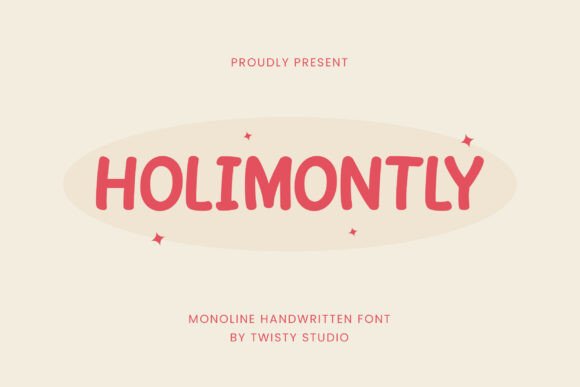
If you've ever spent too long scrolling through font libraries searching for something that feels alive—not just legible, but full of warmth, bounce, and genuine personality—you’ve probably felt the gap between “technically fine” and “emotionally right.” That’s where Holimontly steps in. It’s not just another handwritten font. It’s a monoline, cheerful, energetic typeface built with bold outlines and springy, bouncy strokes—like your favorite doodle given superpowers.
What Makes Holimontly Stand Out (Without Overcomplicating It)
Holimontly is designed to be instantly recognizable—not because it’s flashy or ornate, but because it carries consistent, joyful rhythm. Every letter has the same stroke weight (monoline), yet each one moves with gentle exaggeration: rounded terminals, lifted exits, and subtle swells that mimic the natural lift and pressure of hand-drawn lettering. Unlike many playful fonts that rely on irregularity or texture to feel “human,” Holimontly stays clean and scalable while still radiating friendliness.
That balance matters—especially when you’re working across sizes and surfaces. Whether it’s stamped on a lunchbox, blown up on a mural, or rendered at 14px in a digital kids’ app interface, Holimontly holds its charm without sacrificing clarity.
Where Holimontly Fits Naturally (and Where It Might Surprise You)
Yes, Holimontly shines in obvious places—kids’ books, birthday invitations, sticker sheets—but its real strength lies in how flexibly it adapts to less-expected contexts. Here’s where people are quietly getting great results:
- Early-learning apps and educational tools: Teachers and edtech designers tell us Holimontly helps reduce visual fatigue for emerging readers. Its open counters and generous spacing make letters easier to distinguish—even on lower-resolution tablets or shared classroom screens.
- Small-batch food branding: Think local bakeries, organic juice bars, or handmade soap labels. Holimontly adds approachability without looking childish—especially when paired with a clean sans-serif for body text. One Brooklyn-based jam brand swapped their serif logo for Holimontly + charcoal-gray subtitles—and saw a 22% uptick in social engagement from customers describing the packaging as “warm but not cutesy.”
- Comic lettering and indie zines: Because it’s monoline and bold-outlined, Holimontly works beautifully over sketchy line art or textured backgrounds. Artists use it for speech bubbles, title pages, or chapter headers where consistency matters more than flourish.
- Internal team communications: A surprising number of remote teams use Holimontly in Slack custom emojis, Notion banners, or internal newsletters—not for whimsy alone, but because it subtly signals psychological safety and approachability in asynchronous workspaces.
Who Benefits Most—and How Their Needs Shape Use
Illustrators and surface pattern designers love Holimontly for quick mockups. Since it’s tightly spaced and highly legible at small sizes, they drop it into textile repeats or greeting card layouts without redrawing or kerning adjustments. No need to fake handwriting—it already reads like someone happily wrote it just for you.
Nonprofits focused on youth and family services often choose Holimontly for campaign materials. It conveys care and accessibility without infantilizing audiences. One after-school program in Portland used it across flyers, volunteer badges, and website CTAs—and reported higher parent sign-up completion rates, especially among first-generation families who associated the tone with trustworthiness, not “just for kids.”
Freelance designers building brand identities for solopreneurs find Holimontly speeds up client alignment. When a yoga instructor, a pet-sitter, or a ceramicist says, “I want friendly but professional,” Holimontly delivers that nuance faster than debating between five script fonts that all look vaguely similar.
Practical Considerations Before You Commit
Holimontly isn’t magic—it’s a tool with sweet spots and soft edges. Here’s what thoughtful users keep in mind:
- It’s not ideal for dense body copy. Like most expressive display fonts, Holimontly thrives at headline size (24px and up) or short bursts of emphasis. For paragraphs, pair it with something neutral—think Inter, Poppins, or even Georgia—to let its energy shine without overwhelming.
- Watch contrast in digital use. On low-brightness screens or older devices, the bold outline can sometimes blur if rendered too small. Test at actual usage sizes—not just in your font menu.
- Consider language support. The standard Holimontly package covers Latin-based languages thoroughly (including accented characters common in French, Spanish, and German), but doesn’t include Cyrillic, Greek, or extended Asian character sets. If your project targets multilingual audiences beyond Western Europe, confirm coverage before finalizing.
- Licensing matters more than you think. Holimontly is available under both personal and commercial licenses. If you’re embedding it in a SaaS dashboard, selling merch with it printed, or using it in a client’s national ad campaign, double-check the license tier matches your distribution scope. Many designers overlook this until legal asks—and it’s an easy fix when caught early.
When Holimontly Isn’t the Answer (And What Might Be Better)
Holimontly’s cheerfulness is intentional—and powerful—but it’s not universally appropriate. It may feel tonally mismatched for brands rooted in quiet sophistication (e.g., luxury skincare, financial advisory), serious advocacy (e.g., legal aid, crisis counseling), or technical precision (e.g., engineering firms, medical device interfaces). In those cases, its bounce can unintentionally undercut gravity or authority.
That said, “not right for everything” isn’t a flaw—it’s clarity. Fonts are emotional translators. Holimontly translates joy, energy, and human-centered warmth. If that’s the message your project needs to carry—not just say, but feel—then it’s doing exactly what it was made to do.
Bringing It Into Your Workflow—Without Overthinking
You don’t need special software to start using Holimontly. It’s OpenType-compatible and works smoothly in Adobe Creative Cloud, Figma, Canva, Affinity apps, and even Google Docs (via add-ons). Most users begin by replacing one existing headline—maybe a workshop title, a product tagline, or a newsletter subject line—and simply noticing how the tone shifts. Does it feel lighter? More inviting? More *you*?
That’s the quiet power of Holimontly: it doesn’t shout. It skips, leans in, and makes space for connection—whether you’re designing for a six-year-old learning letters or a 45-year-old launching her first Etsy shop. It’s proof that typography doesn’t have to choose between personality and practicality. Sometimes, the most useful fonts are the ones that make people smile—without them even knowing why.